Nintendo Switch 2 Launch: US Retail Restocks & Exclusive Lineups
Advertisements
The Nintendo Switch 2's debut saw significant US retail activity, characterized by strategic restock deployments and the unveiling of compelling exclusive titles, shaping its initial market reception and consumer demand.
The anticipation surrounding the Nintendo Switch 2 Launch Rollout: Analyzing the First 30 Days of US Retail Restocks and Exclusive Lineups has been palpable, with gamers and industry analysts alike eager to witness its market entry. This new console generation from Nintendo promises to redefine portable and home gaming, building upon the immense success of its predecessor. As the initial weeks unfold, understanding the dynamics of its retail presence and the impact of its exclusive software library becomes crucial for assessing its long-term trajectory and immediate consumer appeal.
The Initial Buzz and Pre-Order Frenzy
The announcement of the Nintendo Switch 2 sparked an immediate wave of excitement, translating into an unprecedented pre-order frenzy across the United States. Retailers struggled to keep up with demand, as eager consumers clamored to secure their units. This initial period set the stage for what would be a dynamic and closely watched launch, demonstrating the brand's enduring power and the console's perceived value.
This early demand was fueled by a combination of factors, including Nintendo's strong brand loyalty, the promise of enhanced hardware, and the rumored lineup of launch titles. Many consumers reported refreshing retail websites constantly, participating in online queues, and even visiting physical stores in hopes of pre-ordering. The sheer volume of pre-orders indicated a successful launch was almost guaranteed, provided Nintendo could meet the supply challenges.
Understanding Pre-Order Dynamics
- Online vs. In-Store: Many retailers opted for staggered online pre-order windows, while some offered limited in-store opportunities, creating diverse access points for consumers.
- Bot Mitigation: Retailers implemented various anti-bot measures, such as CAPTCHAs and queue systems, to ensure fair access for human customers, though success varied.
- Regional Disparities: Pre-order availability often differed by region, with some areas experiencing quicker sell-outs than others, leading to localized demand spikes.
The pre-order phase was a critical indicator of consumer interest and a test of retail infrastructure. While challenging, it successfully built momentum, turning the launch into a major event. The lessons learned during this period would undoubtedly inform future restock strategies.
First 30 Days: US Retail Restock Patterns
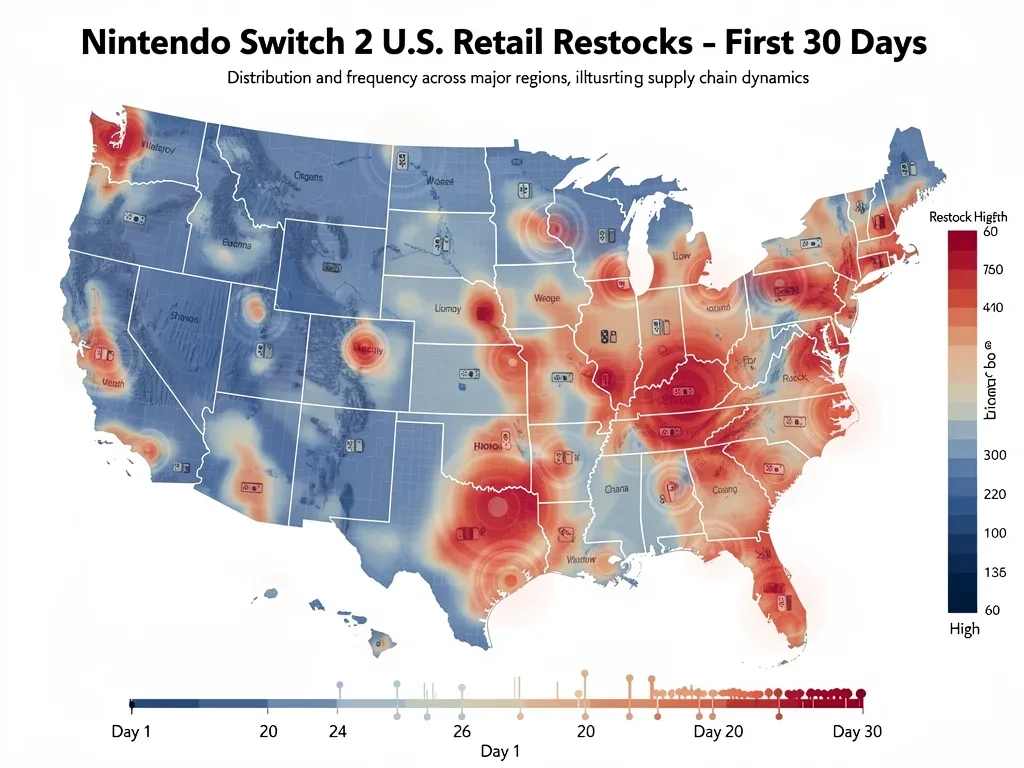
Following the initial launch, the rhythm of retail restocks became the primary focus for consumers who missed the pre-order window. The first 30 days were characterized by sporadic, often unannounced, restocks across major US retailers like GameStop, Best Buy, Amazon, and Walmart. These patterns were crucial in managing demand and preventing scalpers from completely dominating the market, though challenges persisted.
Nintendo and its retail partners seemed to adopt a strategy of smaller, more frequent drops rather than large, infrequent ones. This approach, while frustrating for some, allowed for a more continuous supply stream, albeit one that required constant vigilance from would-be buyers. Online stock alerts and dedicated communities played a significant role in helping consumers track these elusive opportunities.
Major Retailer Strategies
- GameStop: Often prioritized bundles, pairing the console with games or accessories, which helped increase average transaction value and deter some scalpers.
- Best Buy: Frequently used a queue system for online drops, releasing stock in waves to manage server load and give more users a chance.
- Amazon: Known for its unpredictable drops, often appearing at odd hours, making it a challenging but rewarding target for persistent shoppers.
- Walmart: Employed both online and limited in-store restocks, with some physical locations receiving small shipments that sold out almost immediately.
The restock patterns observed during the first month were a delicate balancing act between satisfying consumer demand and maintaining an aura of exclusivity. While not without its frustrations, this managed scarcity strategy likely contributed to sustained interest and buzz around the console.
Exclusive Lineups: The Software Driving Hardware Sales
A console's success is ultimately tied to its software library, and the Nintendo Switch 2 launched with a compelling array of exclusive titles designed to showcase its new capabilities. These games were not merely graphical upgrades but often featured innovative gameplay mechanics, leveraging the console's enhanced processing power and unique control schemes. The exclusive lineup was a critical factor in driving early adoption and maintaining consumer excitement.
From highly anticipated sequels to brand-new intellectual properties, Nintendo ensured there was something for every type of gamer. These exclusives not only provided immediate value but also served as a strong indicator of the console's future potential, promising a rich pipeline of first-party content that has historically been a hallmark of Nintendo platforms.
Key Exclusive Titles at Launch
Several titles stood out as immediate draws for the Nintendo Switch 2. One notable example was Mario Kart 9: Horizon Rush, which introduced dynamic track elements and new character abilities, making it an instant hit for multiplayer enthusiasts. Another highly anticipated game was The Legend of Zelda: Echoes of Time, a sprawling adventure that pushed the boundaries of open-world design on a portable device.
Beyond these flagship titles, Nintendo also delivered a diverse range of smaller, yet equally impactful, exclusives. These included innovative puzzle games, charming platformers, and experimental indie-style experiences developed by internal studios. The breadth of the launch lineup ensured that early adopters had a rich selection of games to explore, justifying their investment in the new hardware.
- Mario Kart 9: Horizon Rush: Enhanced graphics, new tracks, and innovative gameplay modes.
- The Legend of Zelda: Echoes of Time: A vast open world with advanced physics and environmental interactions.
- Pikmin 5: Galactic Garden: Strategic real-time gameplay with stunning visual fidelity.
- Metroid Prime 4: Resurgence: A long-awaited sequel leveraging the Switch 2's power for immersive exploration.
The strategic release of these exclusives not only showcased the Switch 2's capabilities but also solidified Nintendo's commitment to delivering unique, high-quality gaming experiences that are unavailable elsewhere. This strong software foundation is vital for any console's long-term success.

Consumer Reception and Early Feedback
The first 30 days provided ample opportunity for consumers to get their hands on the Nintendo Switch 2 and offer their initial impressions. Overall reception was largely positive, with many praising the console's improved performance, vibrant display, and comfortable ergonomics. The enhanced battery life was also a frequently cited improvement, addressing a common critique of its predecessor.
However, no launch is without its minor criticisms. Some users reported minor software glitches, which are not uncommon for new hardware, and expressed desires for even more advanced graphical capabilities. Despite these minor points, the general consensus pointed towards a successful and well-received console, meeting, and in many cases exceeding, initial expectations.
Key Areas of Feedback
Feedback from early adopters highlighted several key areas. The new HD haptic feedback in the Joy-Cons was particularly well-received, adding a new layer of immersion to gameplay. The faster loading times and smoother frame rates across various titles were also significant improvements that did not go unnoticed. Conversely, discussions around the price point and the availability of certain accessories occasionally surfaced as minor points of contention.
- Positive Feedback:
- Enhanced graphics and performance.
- Improved battery life.
- Comfortable and ergonomic design.
- Innovative new Joy-Con features.
- Areas for Improvement:
- Minor software bugs (expected at launch).
- Desire for even higher resolution output in docked mode.
- Initial accessory availability and pricing.
The overwhelmingly positive consumer reception during the initial launch period bodes well for the Nintendo Switch 2. Addressing minor feedback points will be crucial for Nintendo in subsequent updates and hardware revisions, but the core product has clearly resonated with its target audience.
Impact on the US Gaming Market
The launch of the Nintendo Switch 2 has already had a noticeable impact on the US gaming market. Its introduction has intensified competition within the console space, pushing other manufacturers to re-evaluate their strategies and potentially accelerate their own innovation cycles. The console's hybrid nature continues to carve out a unique niche, appealing to both dedicated home console players and those who prioritize portability.
Beyond direct competition, the Switch 2's presence is also influencing software development trends. Game developers are now considering its unique capabilities when designing new titles, potentially leading to more innovative cross-platform experiences and exclusive content tailored to its ecosystem. This ripple effect extends to accessory manufacturers and digital service providers, all adapting to the new market dynamics.
Market Trends and Future Outlook
The strong launch performance of the Nintendo Switch 2 suggests a healthy future for the console. It reinforces the demand for versatile gaming experiences that seamlessly blend home and on-the-go play. This trend is likely to continue, with future hardware iterations and software releases building upon this foundation. The console's ability to attract both casual and hardcore gamers positions it uniquely in the evolving gaming landscape.
Analysts predict that the Switch 2 will capture a significant market share, especially during key shopping seasons. Its success will also be a barometer for the continued viability of hybrid consoles, potentially inspiring new hardware designs from competitors. The first 30 days have laid a robust groundwork for what could be another iconic console generation for Nintendo.
Challenges and Opportunities Moving Forward
While the initial 30 days of the Nintendo Switch 2 launch in the US have been largely successful, both challenges and opportunities lie ahead. Managing sustained supply to meet ongoing demand will be crucial, especially heading into holiday seasons. Addressing potential hardware or software issues promptly will also be key to maintaining consumer trust and satisfaction. The evolving landscape of digital distribution and subscription services presents both a challenge and an opportunity for Nintendo to innovate its offerings.
On the opportunity front, expanding the console's exclusive game library with compelling new titles and continuing to attract third-party support will be vital. Exploring new accessory innovations that enhance gameplay experiences and potentially integrating more deeply with other Nintendo platforms could further solidify its market position. The community engagement fostered during the launch period also represents a significant asset for future marketing and development efforts.
Key Challenges
- Supply Chain Management: Ensuring consistent availability to prevent stock shortages and combat scalping.
- Software Bug Resolution: Promptly addressing any reported glitches or performance issues through updates.
- Competitive Landscape: Differentiating from other consoles and emerging gaming technologies.
Future Opportunities
- Expanding Exclusive Content: Investing in new first-party titles and securing strong third-party support.
- Accessory Innovation: Developing new peripherals that enhance the Switch 2's unique features.
- Digital Services: Enhancing online features, subscription benefits, and digital storefront experiences.
Navigating these challenges and capitalizing on these opportunities will define the Nintendo Switch 2's long-term success. The foundation laid in the first 30 days is strong, but sustained effort and strategic planning will be essential for it to reach its full potential.
| Key Aspect | Brief Description |
|---|---|
| Pre-Order Demand | High consumer excitement led to rapid sell-outs and challenging pre-order processes. |
| Retail Restocks | Staggered, often unannounced, drops across major US retailers marked the first month. |
| Exclusive Games | Strong launch lineup of first-party titles showcasing new hardware capabilities. |
| Consumer Reception | Generally positive, praising performance and display, with minor software critiques. |
Frequently Asked Questions About the Switch 2 Launch
How frequently did Nintendo Switch 2 restocks occur in the US during the first month?▼Restocks were generally sporadic and often unannounced across major US retailers. Nintendo and its partners seemed to favor smaller, more frequent drops rather than large, predictable ones, requiring consumers to stay vigilant for availability updates.
What were the standout exclusive games available at the Nintendo Switch 2 launch?▼Key exclusive titles included Mario Kart 9: Horizon Rush and The Legend of Zelda: Echoes of Time. These games showcased the console's enhanced capabilities and innovative gameplay, driving significant early adoption among fans.
How did US retailers manage the high demand for the Nintendo Switch 2?▼Retailers employed various strategies, such as online queue systems, anti-bot measures, and bundle offers. Some also had limited in-store availability, attempting to manage server loads and distribute consoles more equitably amidst overwhelming demand.
What was the general consumer feedback on the Nintendo Switch 2's performance?▼Early consumer feedback was largely positive, praising the console's improved graphics, faster loading times, and enhanced battery life. The new HD haptic feedback in the Joy-Cons was also a frequently highlighted improvement.
What impact has the Nintendo Switch 2 had on the US gaming market?▼The Switch 2's launch intensified console competition and influenced software development trends, reinforcing the demand for versatile hybrid gaming experiences. It has also set a new benchmark for portable console performance and innovation.
Conclusion
The initial 30 days of the Nintendo Switch 2's launch in the US have been a testament to Nintendo's continued prowess in the gaming industry. Characterized by intense pre-order demand, strategic retail restocks, and a robust lineup of exclusive titles, the console has made a significant splash. Consumer reception has been overwhelmingly positive, highlighting the success of its enhanced hardware and innovative features. While challenges in supply chain management and continuous innovation lie ahead, the foundation laid during this critical first month suggests a promising future for the Nintendo Switch 2, solidifying its position as a major player in the evolving US gaming market.