Fixing Ping Spikes: Wi-Fi 7 Optimization for Mobile Gamers
Advertisements
Competitive mobile gamers experiencing ping spikes above 90ms can significantly improve their performance by strategically optimizing a Wi-Fi 7 router, leveraging its advanced features for a stable, low-latency connection.
Are you a competitive mobile gamer constantly battling frustrating ping spikes above 90ms? In the fast-paced world of mobile esports, a stable, low-latency connection is not just an advantage—it's a necessity. This article delves into the critical steps for fixing ping spikes above 90ms: Wi-Fi 7 router optimization for competitive mobile gamers, transforming your gameplay experience from laggy frustration to seamless precision.
Understanding ping spikes and their impact on mobile gaming
Ping spikes are the bane of any online gamer's existence, particularly for those engaged in competitive mobile titles where split-second decisions dictate victory or defeat. These sudden, sharp increases in latency can manifest as frustrating delays, teleporting characters, or missed actions, severely hindering performance and enjoyment.
For competitive mobile gamers, ping above 90ms is often considered unplayable, leading to a significant disadvantage against opponents with more stable connections. Understanding what causes these spikes is the first step toward mitigating them.
What causes high ping in mobile gaming?
Several factors contribute to high ping, ranging from network congestion to router settings and even the distance from your access point. Identifying the root cause is crucial for effective troubleshooting.
- Network congestion: Too many devices on your network, or heavy internet usage, can saturate your bandwidth.
- Wi-Fi interference: Signals from neighboring networks or household appliances can disrupt your Wi-Fi signal.
- Suboptimal router placement: Walls, floors, and other obstacles can weaken your Wi-Fi signal strength.
- Outdated router technology: Older routers may lack the advanced features needed to handle modern gaming demands.
The impact of high ping extends beyond mere inconvenience; it directly affects your ability to react, aim, and communicate effectively in-game. Even a momentary spike can cost you a crucial match, making dedicated optimization a priority for serious players.
In essence, a stable and low ping is the bedrock of competitive mobile gaming. Recognizing the sources of ping spikes and their detrimental effects provides the necessary motivation to explore advanced solutions like Wi-Fi 7 optimization.
Why Wi-Fi 7 is a game-changer for mobile gamers
Wi-Fi 7, also known as 802.11be or Extremely High Throughput (EHT), represents the next frontier in wireless networking. It brings a host of innovations specifically designed to address the latency and bandwidth demands of modern applications, including competitive mobile gaming.
Unlike its predecessors, Wi-Fi 7 isn't just about faster speeds; it's about unparalleled efficiency, reliability, and reduced latency. These characteristics are precisely what competitive mobile gamers need to maintain a consistent edge.
Key Wi-Fi 7 features for low latency
Several technological advancements in Wi-Fi 7 directly contribute to a superior gaming experience, particularly in combating ping spikes.
- Multi-Link Operation (MLO): MLO allows devices to simultaneously send and receive data across different frequency bands (2.4 GHz, 5 GHz, and 6 GHz). This significantly increases throughput and reduces latency by providing multiple pathways for data, making your connection more resilient to interference and congestion.
- 320 MHz channels: Wi-Fi 7 introduces ultra-wide 320 MHz channels in the 6 GHz band, offering massive bandwidth. This provides dedicated, clear spectrum for high-demand applications like gaming, minimizing bottlenecks.
- Preamble puncturing: This feature allows a Wi-Fi 7 router to 'puncture' or skip over portions of a wide channel that are being used by other devices. This means that even if a part of a 320 MHz channel is busy, the router can still use the remaining clear segments, maximizing channel utilization and reducing waiting times.
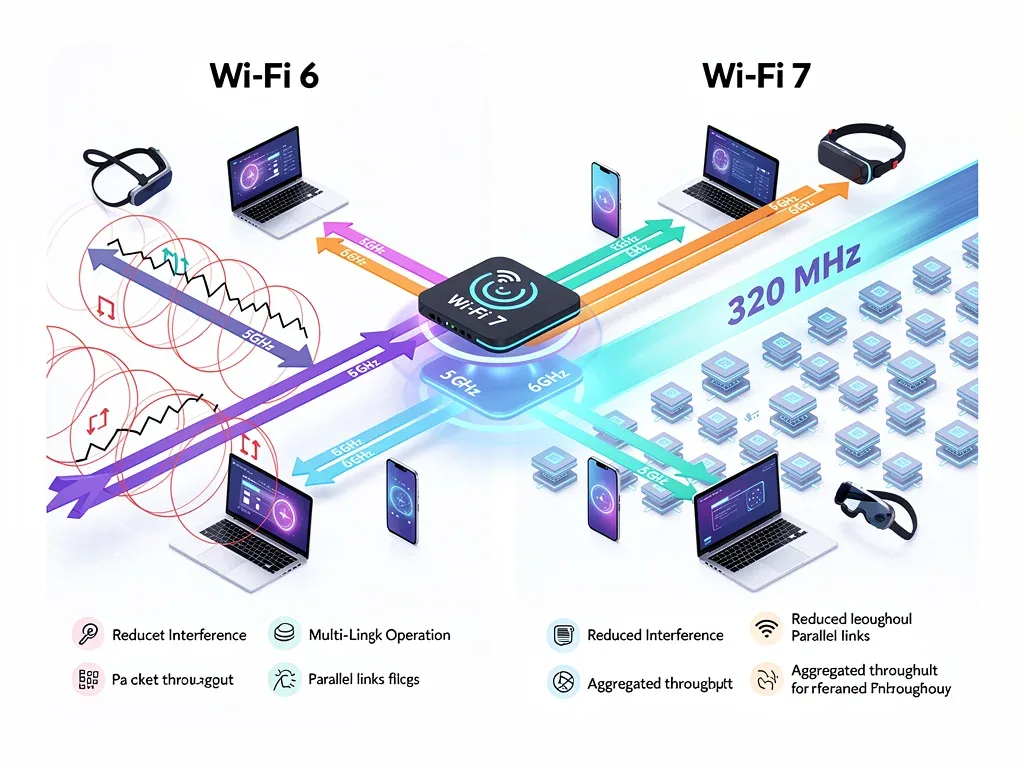
These features collectively create a robust and highly responsive wireless environment. MLO ensures that even if one band experiences interference, your data can seamlessly switch or be transmitted over another, maintaining a stable connection crucial for gaming.
The introduction of the 6 GHz band, coupled with wider channels, offers a pristine, less congested highway for your gaming data, far from the crowded 2.4 GHz and 5 GHz bands used by older devices. Wi-Fi 7's intelligent channel management further refines this, making it an indispensable tool for serious mobile gamers aiming to eliminate ping spikes.
Optimal Wi-Fi 7 router placement and environment
Even the most advanced Wi-Fi 7 router won't perform optimally if not positioned correctly. Strategic placement is a fundamental step in ensuring a strong, stable signal and minimizing interference, directly impacting your ping stability.
The physical environment plays a significant role in how effectively your Wi-Fi signal travels. Understanding and mitigating these environmental factors can yield substantial improvements in latency.
Strategic router positioning
Where you place your router can dramatically affect signal strength and coverage. Aim for a central location, elevated, and away from obstructions.
- Central location: Place the router as close as possible to your primary gaming area. If you game in multiple rooms, try to find a central point that minimizes distance to all.
- Elevated position: Wi-Fi signals tend to spread downwards. Placing your router on a high shelf or tabletop helps the signal propagate more effectively throughout your home.
- Line of sight: Minimize physical barriers between your router and gaming device. Walls, floors, and large furniture can absorb or reflect Wi-Fi signals, leading to signal degradation and increased latency.
Beyond simple placement, consider the type of materials in your home. Concrete, brick, and metal are notorious for blocking Wi-Fi signals more effectively than wood or drywall. Positioning your router to avoid these dense materials can make a noticeable difference.
Minimizing environmental interference
Your home is filled with devices that can interfere with your Wi-Fi signal. Identifying and mitigating these sources is key to a clean, stable connection.
- Other wireless devices: Cordless phones, microwaves, Bluetooth devices, and even baby monitors can operate on similar frequencies, causing interference. Keep your router away from these appliances.
- Neighboring Wi-Fi networks: In densely populated areas, your neighbors' Wi-Fi networks can compete for the same channels. Wi-Fi 7's 6 GHz band is less susceptible to this, but optimizing channel selection on other bands remains important.
- Reflective surfaces: Large mirrors, metal objects, and even fish tanks can reflect or absorb Wi-Fi signals. Try to avoid placing your router directly next to or facing such surfaces.
By carefully considering both physical placement and potential sources of interference, you create an optimal environment for your Wi-Fi 7 router to deliver its best performance, directly contributing to lower, more stable ping values.
Configuring your Wi-Fi 7 router for competitive gaming
Beyond physical placement, the true power of a Wi-Fi 7 router for competitive mobile gaming lies in its advanced configuration options. Proper setup can prioritize gaming traffic, minimize latency, and ensure your connection remains steadfast even during peak network usage.
Accessing your router's administrative interface is the first step to unlocking these performance enhancements. Most routers allow access via a web browser by typing in their IP address (often 192.168.1.1 or 192.168.0.1).
Prioritizing gaming traffic with QoS (Quality of Service)
Quality of Service (QoS) is a crucial feature that allows you to prioritize certain types of network traffic over others. For competitive gaming, this means ensuring your game data gets preferential treatment.
- Enable QoS: Locate the QoS settings in your router's interface.
- Prioritize gaming devices/applications: Many Wi-Fi 7 routers offer built-in gaming modes or allow you to manually prioritize specific devices (your gaming smartphone) or applications (your mobile game). Set your gaming device to the highest priority.
- Bandwidth allocation: Some advanced QoS settings allow you to reserve a certain amount of bandwidth specifically for gaming. This prevents other devices from hogging the connection when you're playing.
By implementing QoS, you create a dedicated fast lane for your gaming data, ensuring that even if someone else is streaming 4K video or downloading large files, your game's latency remains unaffected.
Optimizing Wi-Fi 7 specific features
Leverage the unique capabilities of your Wi-Fi 7 router to further reduce ping.
- Enable Multi-Link Operation (MLO): Ensure MLO is active. This feature allows your device to use multiple frequency bands simultaneously, enhancing reliability and reducing latency.
- Utilize the 6 GHz band: If your mobile gaming device supports Wi-Fi 6E or Wi-Fi 7, connect to the 6 GHz band. This band is less congested and offers wider channels, providing a cleaner, faster connection.
- Channel selection: While Wi-Fi 7's 6 GHz band is inherently less congested, for the 2.4 GHz and 5 GHz bands, use a Wi-Fi analyzer app to identify the least congested channels and manually select them in your router settings.
Regularly updating your router's firmware is also paramount. Manufacturers often release updates that improve performance, enhance security, and optimize Wi-Fi 7 features. A well-configured Wi-Fi 7 router, with its advanced features properly utilized, provides the robust and low-latency foundation competitive mobile gamers need to excel.
Advanced troubleshooting for persistent ping issues
Even with optimal Wi-Fi 7 router setup, some competitive mobile gamers might still encounter persistent ping spikes. When basic optimizations don't fully resolve the issue, it's time to delve into more advanced troubleshooting techniques to pinpoint and eliminate the underlying causes.
These methods often require a deeper understanding of network diagnostics and can help uncover less obvious sources of latency.
Diagnosing network congestion and interference
Understanding what's happening on your network is key to advanced troubleshooting. Tools and techniques exist to help you visualize your network's health.
- Wi-Fi analyzer apps: Use apps like Wi-Fi Analyzer (Android) or similar tools on iOS (though more restricted) to visualize surrounding Wi-Fi networks, signal strengths, and channel usage. This can help identify interference from neighbors.
- Router's client list: Check your router's administrative interface for a list of connected devices. Identify any unknown devices or those consuming excessive bandwidth.
- Monitor bandwidth usage: Many Wi-Fi 7 routers offer built-in tools to monitor real-time bandwidth usage per device. This helps identify bandwidth hogs that might be causing spikes.
If you find that your network is indeed congested, consider implementing strict QoS rules for non-gaming devices or scheduling heavy downloads/uploads for off-peak hours.
Firmware updates and router resets
Sometimes, the simplest solutions are the most effective. Keeping your router's software up-to-date and occasionally giving it a fresh start can resolve many elusive network problems.
- Check for firmware updates: Regularly visit your router manufacturer's website for the latest firmware. Firmware updates often include performance enhancements, bug fixes, and security patches critical for optimal operation.
- Soft reset vs. hard reset: A soft reset (power cycling by unplugging for 30 seconds) can clear temporary glitches. A hard reset (factory reset) restores the router to its default settings, which can fix deep-seated configuration issues, but requires reconfiguring all your settings.
- Test with minimal devices: Disconnect all non-essential devices from your Wi-Fi network and test your ping. If performance improves, gradually reintroduce devices to identify the culprit.
By systematically diagnosing and addressing these advanced factors, competitive mobile gamers can often conquer even the most stubborn ping spikes, ensuring a consistently smooth and responsive gaming experience. Persistence and methodical testing are your best allies here.
Optimizing your mobile device for low latency gaming
While a Wi-Fi 7 router is a powerful tool, optimizing your mobile gaming device itself is equally crucial for achieving the lowest possible latency and preventing ping spikes. A well-configured smartphone or tablet can make the most of your high-performance network.
These device-side optimizations ensure that your mobile hardware and software are not creating additional bottlenecks or unnecessary processing delays.
Device settings for peak gaming performance
Several settings on your mobile device can be adjusted to prioritize gaming performance and reduce background interference.
- Enable game mode: Many modern smartphones have a dedicated 'Game Mode' that optimizes CPU/GPU performance, blocks notifications, and sometimes prioritizes network traffic for games.
- Disable background app refresh: Turn off background app refresh for non-essential applications. This prevents apps from consuming bandwidth and processing power in the background.
- Close unnecessary apps: Before launching your game, close all other open applications to free up RAM and CPU resources.
- Clear cache: Periodically clear the cache of your gaming app and your device's system cache. Accumulated cache data can sometimes lead to performance issues.

These simple adjustments ensure that your device is dedicating its full resources to running the game smoothly, minimizing any internal delays that could contribute to perceived latency.
Network settings on your mobile device
Beyond general device optimization, specific network settings on your mobile device can also be fine-tuned to complement your Wi-Fi 7 setup.
- Connect to the 6 GHz band: If your device supports Wi-Fi 6E or Wi-Fi 7, ensure it's connected to the 6 GHz network broadcast by your router. This band offers the least interference and highest throughput.
- Forget old Wi-Fi networks: Your device might try to connect to weaker, known networks. Forgetting these can prevent it from latching onto a suboptimal connection.
- Disable VPNs: Unless absolutely necessary for your game, disable any VPN services. VPNs encrypt and reroute your internet traffic, which almost always adds latency.
- Keep device software updated: Ensure your mobile device's operating system and game applications are always updated to their latest versions. Updates often include network driver improvements and performance optimizations.
By combining a robust Wi-Fi 7 router setup with these targeted mobile device optimizations, competitive mobile gamers can create a powerful, low-latency ecosystem, virtually eliminating ping spikes and ensuring a consistently smooth and responsive gaming experience.
Future-proofing your mobile gaming setup with Wi-Fi 7
Investing in Wi-Fi 7 for competitive mobile gaming is not just about solving current ping issues; it's about preparing your setup for the evolving demands of future mobile esports titles and network technologies. As games become more graphically intensive and require even faster response times, Wi-Fi 7's capabilities will become increasingly indispensable.
This forward-thinking approach ensures that your gaming environment remains competitive and cutting-edge for years to come, protecting your investment and enhancing your long-term gaming enjoyment.
The longevity of Wi-Fi 7 for gaming
Wi-Fi 7 is designed with future scalability in mind. Its advanced features offer a significant leap over previous generations, providing ample headroom for upcoming technological advancements.
- Increased bandwidth: The massive 320 MHz channels and higher theoretical speeds mean Wi-Fi 7 can comfortably handle future games with larger data requirements and higher fidelity.
- Improved efficiency: Features like MLO and preamble puncturing ensure that Wi-Fi 7 networks remain efficient and low-latency even as more devices come online and network traffic increases.
- 6 GHz band utilization: The relatively uncongested 6 GHz band offers a dedicated highway for high-performance applications, a benefit that will only grow in importance as other bands become more crowded.
By adopting Wi-Fi 7 now, you're not just upgrading; you're future-proofing your entire home network for the next generation of mobile gaming and beyond.
Beyond ping: other benefits for competitive players
While low ping is the primary concern for competitive gamers, Wi-Fi 7 offers other benefits that enhance the overall gaming experience.
- Faster downloads and updates: With significantly higher speeds, game downloads and updates will complete much faster, getting you into the action sooner.
- Smoother streaming: If you stream your mobile gameplay, Wi-Fi 7's increased bandwidth and efficiency will provide a more stable and higher-quality stream.
- Better multi-device performance: Even with multiple household members using the internet, Wi-Fi 7's advanced traffic management ensures that everyone's experience, including your gaming, remains optimal.
Ultimately, a Wi-Fi 7 router is more than just a piece of network hardware; it's a strategic investment for any serious competitive mobile gamer. It provides the foundation for consistent, lag-free performance, ensuring you can always compete at your highest level and enjoy the cutting edge of mobile gaming technology for years to come.
| Key Optimization | Brief Description |
|---|---|
| Wi-Fi 7 Router | Upgrade to Wi-Fi 7 for MLO, 320 MHz channels, and 6 GHz band for superior latency. |
| Router Placement | Ensure central, elevated placement away from obstructions and interference sources. |
| QoS Configuration | Prioritize gaming traffic and your mobile device using Quality of Service settings. |
| Device Optimization | Enable game modes, close background apps, and ensure device software is updated. |
Frequently Asked Questions About Wi-Fi 7 Gaming
What is the primary benefit of Wi-Fi 7 for competitive mobile gamers?▼The primary benefit is significantly reduced and more stable latency, thanks to features like Multi-Link Operation (MLO) and wider 320 MHz channels in the uncongested 6 GHz band. This directly combats ping spikes above 90ms, providing a smoother, more responsive gaming experience essential for competitive play.
Do I need a Wi-Fi 7 compatible phone to benefit from a Wi-Fi 7 router?▼To fully leverage all Wi-Fi 7 features, yes, your mobile device needs to be Wi-Fi 7 compatible. However, even Wi-Fi 6E devices can benefit from the 6 GHz band, which offers reduced congestion and improved performance compared to older bands, even if they don't support full Wi-Fi 7 features.
How does Multi-Link Operation (MLO) help reduce ping?▼MLO allows your device and router to use multiple Wi-Fi bands (2.4 GHz, 5 GHz, 6 GHz) simultaneously for data transmission. This redundancy and increased bandwidth make the connection more resilient to interference and congestion, resulting in lower and more consistent latency, thus preventing ping spikes.
What are the best router settings to prioritize gaming traffic?▼Utilize your router's Quality of Service (QoS) settings to prioritize your gaming mobile device or the specific game application. Assign it the highest priority, and if available, allocate dedicated bandwidth. Ensure MLO is enabled and connect to the 6 GHz band for optimal performance.
Can environmental factors still cause ping spikes with a Wi-Fi 7 router?▼Yes, environmental factors like physical obstructions (walls, metal), interference from other wireless devices, and poor router placement can still degrade Wi-Fi 7 performance. Optimal router positioning and minimizing interference sources are crucial even with the latest technology.
Conclusion
For competitive mobile gamers, eradicating ping spikes above 90ms is paramount to achieving peak performance and truly enjoying the immersive experience modern mobile titles offer. The advent of Wi-Fi 7 technology presents a robust solution, bringing unprecedented levels of speed, efficiency, and most importantly, low latency to wireless networks. By strategically upgrading to a Wi-Fi 7 router, optimizing its placement and configuration, and fine-tuning your mobile device settings, you can transform a frustrating, lag-ridden experience into one of seamless, responsive gameplay. Embracing Wi-Fi 7 is not merely an upgrade; it's a strategic investment in future-proofing your mobile gaming setup, ensuring you remain at the top of your game as technology continues to evolve.