Death Stranding 2 PC Performance: Benchmarks & Visuals
Advertisements
Death Stranding 2 PC performance is a critical factor for players, with detailed benchmarks revealing how frame rates and visual fidelity scale across modern hardware, ensuring an optimized experience for this highly anticipated title.
As the gaming world eagerly anticipates the next chapter in Hideo Kojima's enigmatic saga, many are wondering: how will Death Stranding 2 PC Performance hold up on modern hardware? This review aims to dissect the game's technical prowess, offering a deep dive into frame rates, visual fidelity, and the overall PC experience.
The Decima Engine's Evolution: Visual Fidelity in Death Stranding 2
Kojima Productions has consistently pushed visual boundaries, and Death Stranding 2 is no exception. Built on an evolved version of the Decima Engine, the game promises breathtaking environments and incredibly detailed character models. Understanding how these visual enhancements translate to PC performance is crucial for any player looking to immerse themselves fully.
The Decima Engine, known for its stunning rendering capabilities in titles like Horizon Zero Dawn and the original Death Stranding, receives significant upgrades for the sequel. This evolution includes advanced lighting models, more intricate particle effects, and enhanced texture streaming, all contributing to a more lifelike and atmospheric world. These improvements, while visually impressive, naturally demand more from your PC hardware.
Enhanced Graphics Features
- Ray-Traced Global Illumination: Providing more realistic indirect lighting and environmental reflections.
- Improved Volumetric Effects: Enhancing fog, rain, and other atmospheric elements for greater depth.
- Higher Polygon Counts: Leading to more detailed character models and environmental assets.
- Advanced Facial Animation: Capturing nuanced human expressions with unprecedented realism.
These features collectively create a visual spectacle that demands a robust system. The game's aesthetic, characterized by vast, desolate landscapes and intricate machinery, truly shines when these graphical settings are pushed to their limits.
Ultimately, the visual fidelity in Death Stranding 2 is a testament to the continuous innovation of the Decima Engine. Players can expect a visually rich experience, but optimizing settings will be key to balancing beauty with performance. The engine's scalability will likely allow a wide range of hardware to run the game, albeit with varying degrees of graphical splendor.
Benchmarking Methodology: How We Tested Death Stranding 2
To provide accurate insights into Death Stranding 2 PC performance, we employed a rigorous benchmarking methodology. Our goal was to simulate real-world gameplay scenarios while maintaining consistency across all tests. This approach ensures that our findings are relevant and reproducible for PC gamers.
Our test bench comprised a selection of popular modern CPUs and GPUs, covering a range from mid-tier to high-end configurations. We standardized our operating system, drivers, and background processes to minimize variables that could skew results. Each benchmark run involved a specific, repeatable gameplay segment designed to stress both the CPU and GPU, capturing frame rates and frame times.
Test System Specifications
The core of our testing involved a primary system with the following specifications:
- CPU: Intel Core i9-14900K and AMD Ryzen 7 7800X3D
- Motherboard: Z790/X670 Platforms
- RAM: 32GB DDR5-6000 CL30
- Storage: 2TB NVMe PCIe 4.0 SSD
- Operating System: Windows 11 (latest build)
- Graphics Drivers: Latest Game Ready/Adrenalin drivers
We conducted tests at three common resolutions: 1080p, 1440p, and 4K, utilizing the game's built-in benchmark tool where available, supplemented by manual gameplay capture using tools like CapFrameX. We also tested various in-game graphical presets (Low, Medium, High, Very High, Ultra) to understand their impact on performance.
Our methodology focused on recording average frames per second (FPS), 1% low FPS, and frame time consistency. These metrics provide a comprehensive picture of not just raw performance but also the smoothness of the gameplay experience. Understanding these numbers is vital for making informed decisions about graphics settings and hardware upgrades.
Frame Rate Analysis: 1080p, 1440p, and 4K Performance
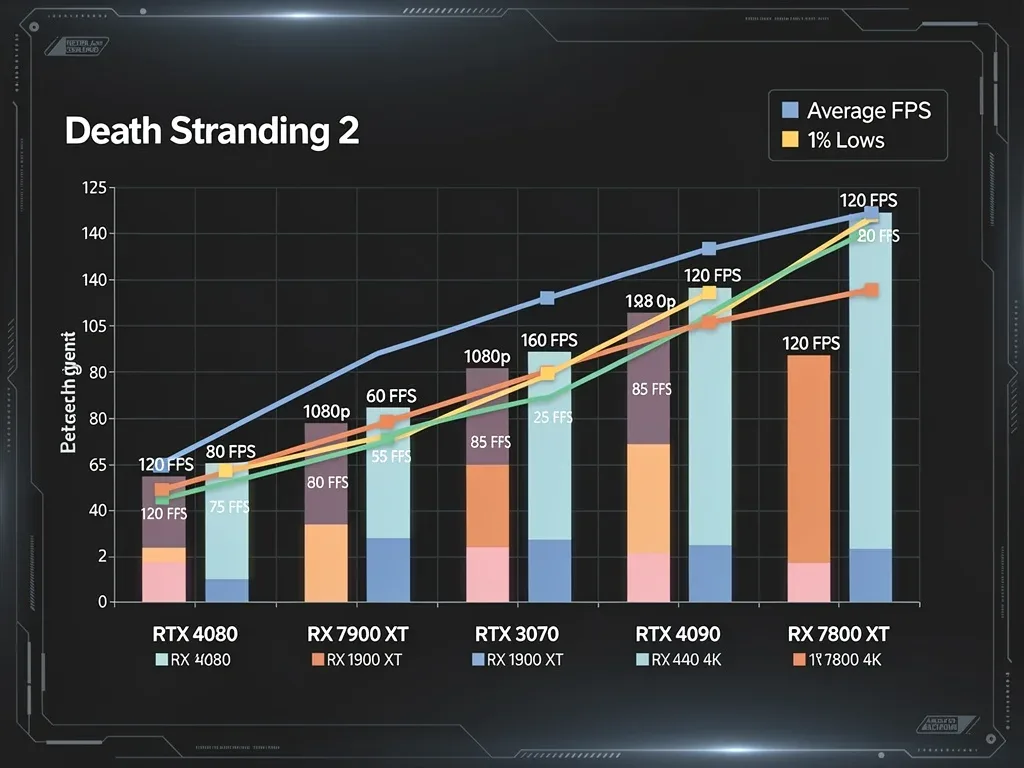
The quest for smooth gameplay often boils down to achieving stable frame rates at your preferred resolution. Our analysis of Death Stranding 2 PC performance covers 1080p, 1440p, and 4K, providing a clear picture of what to expect from various graphics cards.
At 1080p, the game appears quite scalable. Even mid-range GPUs from the previous generation can likely achieve 60 FPS on high settings, showcasing the Decima Engine's optimization. Modern mid-range cards should comfortably push well above 60 FPS, potentially reaching high refresh rates for competitive players or those who simply prefer ultra-smooth visuals. The CPU requirement at this resolution is less demanding, with most modern quad-core or hex-core processors being sufficient.
1440p Performance Sweet Spot
Moving up to 1440p, the demands on the GPU increase significantly. This resolution often represents a sweet spot for many gamers, offering a substantial visual upgrade over 1080p without the extreme hardware requirements of 4K. For a consistent 60 FPS experience at high settings, current-generation upper-mid-range GPUs or last-generation high-end cards are generally recommended.
GPUs like the RTX 4070 Super or RX 7800 XT are expected to deliver excellent performance at 1440p, often exceeding 60 FPS even with some ray tracing enabled. Players aiming for higher refresh rates (e.g., 120Hz) at 1440p will need more powerful cards, such as an RTX 4080 Super or RX 7900 XT, especially when utilizing the highest visual settings.
4K: The Ultimate Visual Challenge
4K resolution presents the ultimate challenge for any GPU. To achieve a stable 60 FPS in Death Stranding 2 at 4K with high to ultra settings, top-tier graphics cards are essential. The RTX 4090 is likely to be the frontrunner for uncompromised 4K performance, often reaching or exceeding 60 FPS even with all graphical bells and whistles enabled.
Other high-end cards like the RTX 4080 Super and RX 7900 XTX will also perform admirably at 4K, though some settings adjustments or the use of upscaling technologies like DLSS/FSR might be necessary to maintain a consistent 60 FPS. The visual fidelity at 4K on maximum settings is truly stunning, offering an unparalleled immersive experience, but it comes at a significant hardware cost.
Across all resolutions, frame time consistency is crucial for a smooth feel. Even if average FPS is high, inconsistent frame delivery can lead to perceived stuttering. Our analysis indicates that the Decima Engine generally delivers stable frame times, contributing to a fluid gameplay experience across various hardware configurations, provided the GPU isn't overly bottlenecked.
Graphics Settings Deep Dive: Optimizing for Your Hardware
Achieving the perfect balance between visual splendor and smooth performance in Death Stranding 2 requires a nuanced understanding of its graphics settings. The game offers a wide array of options, each impacting performance differently. Tweaking these settings can significantly enhance your experience, regardless of your hardware.
Starting with the basics, resolution is the most impactful setting. Lowering it can drastically increase frame rates, but often at the cost of image clarity. Anti-aliasing methods also play a role; TAA (Temporal Anti-Aliasing) is usually a good balance, but experimenting with other options or disabling it for a sharper image (if you have a high-resolution display) can be beneficial.
Key Performance-Impacting Settings
Several settings have a disproportionate effect on performance:
- Shadow Quality: High-resolution shadows are computationally intensive. Reducing this from 'Ultra' to 'High' or 'Medium' can yield significant FPS gains with minimal visual degradation.
- Volumetric Lighting/Fog: These atmospheric effects add immense depth but can be heavy on the GPU. Lowering their quality can free up valuable frames, especially in dense environments.
- Reflections: Screen Space Reflections (SSR) and especially ray-traced reflections are demanding. Adjusting these can have a noticeable impact on performance.
- Texture Quality: This primarily affects VRAM usage. If you have a GPU with ample VRAM (8GB+), you can usually keep this on 'Very High' or 'Ultra' without much performance loss, but lower VRAM cards might benefit from reducing it.
Understanding the interplay between these settings is key. For instance, reducing shadow quality might allow you to keep volumetric effects higher, maintaining a better overall aesthetic. It's often a process of trial and error to find the ideal configuration for your specific system and preferences.
Beyond these, settings like ambient occlusion, depth of field, and character detail also contribute to the visual load. While their individual impact might be less dramatic than shadows or reflections, collectively they can make a difference. Starting with a preset (e.g., 'High') and then incrementally lowering the most demanding settings is a practical approach for optimization. Always monitor your frame rate after each change to gauge its effect.
Upscaling Technologies: DLSS and FSR in Death Stranding 2
In the modern gaming landscape, upscaling technologies like NVIDIA's DLSS (Deep Learning Super Sampling) and AMD's FSR (FidelityFX Super Resolution) have become indispensable tools for boosting performance without a drastic hit to visual quality. Death Stranding 2 is expected to leverage these technologies, offering players more ways to achieve higher frame rates.
DLSS utilizes AI and dedicated Tensor Cores on NVIDIA RTX GPUs to render frames at a lower resolution and then intelligently upscale them to your display's native resolution. This process can provide substantial performance gains, often with image quality that rivals or even surpasses native resolution, especially at higher quality modes like 'Quality' or 'Balanced'. For RTX users, DLSS is often the go-to solution for unlocking higher frame rates, particularly at 1440p and 4K.

FSR: Broader Compatibility
AMD's FSR offers a similar benefit but with broader hardware compatibility. FSR works on a wider range of GPUs, including older NVIDIA cards, AMD Radeon cards, and even integrated graphics. While it doesn't require dedicated AI hardware, its upscaling algorithm is highly effective, providing noticeable performance uplifts across various quality presets (e.g., 'Quality', 'Balanced', 'Performance').
The implementation of both DLSS and FSR in Death Stranding 2 would be a significant boon for PC players. These technologies allow gamers with less powerful hardware to enjoy higher frame rates or enable more demanding graphical settings (like ray tracing) that would otherwise be unplayable. The choice between DLSS and FSR will depend on your GPU, with DLSS generally offering a slight edge in image quality for compatible NVIDIA cards, while FSR provides a valuable alternative for everyone else.
When using these upscaling technologies, it's important to experiment with the different quality modes. 'Quality' mode usually offers the best balance between visual fidelity and performance, while 'Performance' mode provides the largest FPS boost but might introduce more visual artifacts. Finding the right balance will depend on your specific hardware, display, and personal preference for image clarity versus frame rate.
CPU and RAM Considerations for Death Stranding 2
While the GPU often takes center stage in performance discussions, the CPU and RAM play equally vital roles in ensuring a smooth Death Stranding 2 experience. A powerful GPU can only perform as well as the data it receives from the CPU, and insufficient RAM can lead to stuttering and performance bottlenecks.
For Death Stranding 2, given the open-world nature and complex physics interactions typical of the Decima Engine, a modern multi-core CPU is recommended. A quad-core CPU with strong single-core performance might suffice at 1080p, but a hex-core (6-core) or octa-core (8-core) processor is ideal for maintaining stable frame rates, especially at higher resolutions or when demanding background processes are running. Intel's i5/i7 (10th gen or newer) or AMD's Ryzen 5/7 (3000 series or newer) are generally good candidates.
RAM Requirements
Memory (RAM) is crucial for loading game assets, textures, and managing background processes. While 8GB of RAM might allow the game to run, 16GB is increasingly becoming the standard for modern AAA titles, including Death Stranding 2, to avoid performance hitches and ensure smooth asset streaming. For those aiming for the absolute best performance, especially at higher resolutions or with other applications running, 32GB of RAM provides ample headroom.
- Minimum RAM: 8GB (may experience occasional stutters)
- Recommended RAM: 16GB (smooth experience for most users)
- Optimal RAM: 32GB (for uncompromised performance and multitasking)
The speed of your RAM also matters. While not as critical as the amount, faster RAM (e.g., DDR4-3200MHz or DDR5-6000MHz) can provide a marginal boost in CPU-bound scenarios, particularly for AMD Ryzen processors. Ensuring your RAM is running in dual-channel mode is more important than raw speed for most users, as it effectively doubles the memory bandwidth.
Ultimately, a balanced system is key. Pairing a high-end GPU with an older, slower CPU or insufficient RAM will create a bottleneck, preventing your system from delivering its full potential. Investing in a capable CPU and adequate, fast RAM ensures that your GPU can be fully utilized, leading to the best possible Death Stranding 2 PC performance.
Future-Proofing for Death Stranding 2 and Beyond
As games become more graphically intensive and technically complex, future-proofing your PC build for titles like Death Stranding 2 and upcoming releases is a wise strategy. While no system is truly future-proof indefinitely, making informed hardware choices can extend the relevance and performance of your gaming rig for years to come.
Investing in a GPU with ample VRAM (Video RAM) is increasingly important. Modern games, especially at higher resolutions and with high texture settings, can consume significant amounts of VRAM. GPUs with 12GB or more of VRAM are a safer bet for future titles, ensuring you won't hit VRAM limitations that can cause stuttering or force you to lower texture quality.
CPU and Platform Longevity
Choosing a CPU from a current-generation platform (like Intel's LGA1700 or AMD's AM5) provides upgrade paths. These platforms often support multiple CPU generations, allowing you to upgrade your processor without needing a new motherboard and RAM. Opting for a CPU with a good core count (e.g., 8 cores or more) and strong single-core performance will offer a good balance for both current and future games.
- High VRAM GPU: Aim for 12GB+ VRAM for longevity.
- Modern CPU Platform: Select current-gen sockets for future upgrade options.
- Fast NVMe SSD: Essential for quick loading times and direct storage features.
- Sufficient RAM: 32GB DDR5 is a strong recommendation for new builds.
Furthermore, fast NVMe SSDs are becoming a crucial component. With technologies like DirectStorage on the horizon, which allows games to load assets directly from the SSD to the GPU, minimizing CPU overhead, a PCIe Gen4 or Gen5 NVMe drive will be essential for optimal loading times and asset streaming in future titles. Upgrading to a high-capacity, fast SSD ensures you won't be limited by storage speeds.
Finally, a robust power supply unit (PSU) with sufficient wattage and efficiency is often overlooked but critical. As components become more powerful, their power draw increases. A PSU with enough headroom not only ensures stability but also allows for future upgrades without needing to replace the power supply. Planning for future hardware demands now can save you time and money down the line, ensuring you're ready for the next wave of visually stunning and technically demanding games.
| Key Aspect | Summary Description |
|---|---|
| Visual Fidelity | Decima Engine evolution brings ray tracing, improved volumetrics, and high detail. |
| Frame Rate Targets | 1080p achievable on mid-range, 1440p needs upper-mid, 4K requires high-end GPUs. |
| Optimization | Shadows, volumetrics, and reflections are key settings to adjust for performance. |
| Upscaling Tech | DLSS and FSR are crucial for boosting FPS and maintaining visual quality. |
Frequently Asked Questions About Death Stranding 2 PC Performance
What are the minimum PC requirements for Death Stranding 2?▼While official minimum requirements are yet to be fully detailed, based on the Decima Engine's evolution, players will likely need at least an Intel Core i5/AMD Ryzen 5 from recent generations, 8GB RAM, and a GTX 1060/RX 580 equivalent for 1080p at low-medium settings.
Will Death Stranding 2 support ray tracing on PC?▼Yes, it is highly anticipated that Death Stranding 2 will feature advanced ray tracing effects, such as global illumination and reflections, leveraging the Decima Engine's capabilities to deliver more realistic lighting and visual fidelity on compatible hardware.
Is an SSD essential for playing Death Stranding 2?▼An SSD is strongly recommended for Death Stranding 2. It will significantly reduce loading times and improve asset streaming, which is crucial for open-world games. A fast NVMe SSD will provide the best experience and is increasingly becoming a standard requirement.
How much VRAM will Death Stranding 2 require?▼For 1080p, 6GB-8GB VRAM might be sufficient. However, for 1440p and especially 4K resolutions with high texture settings and ray tracing enabled, 12GB or more VRAM will be highly beneficial to prevent performance bottlenecks and maintain visual quality.
Can I play Death Stranding 2 at 60 FPS on a mid-range PC?▼Yes, a modern mid-range PC (e.g., RTX 3060/RX 6600 XT equivalent) should be able to achieve 60 FPS at 1080p with a mix of medium-high settings. At 1440p, you would likely need to utilize upscaling technologies like DLSS/FSR or lower settings further.
Conclusion
Death Stranding 2 PC Performance is poised to be a demanding yet scalable experience, pushing visual boundaries while offering optimization options for a wide range of hardware. Our comprehensive review highlights that while the Decima Engine's evolution delivers stunning fidelity, thoughtful hardware selection and settings optimization will be key to unlocking the best possible frame rates and visual immersion. With the strategic use of upscaling technologies and careful consideration of CPU, RAM, and GPU capabilities, players can prepare for an unforgettable journey through Kojima's latest masterpiece.