Ray Tracing on Mobile: Frame Rate Drops & 2026 Presets
Advertisements
Ray tracing significantly impacts mobile frame rates, often causing drops of up to 45%, due to intensive computational demands on limited mobile hardware. Optimizing graphic presets is crucial for a balanced 2026 AAA mobile gaming experience.
Have you ever wondered why your cutting-edge mobile device struggles when you enable ray tracing in the latest AAA games? The impact can be dramatic, with frame rates plummeting by as much as 45%.
The Computational Chasm: Why Ray Tracing Taxes Mobile Hardware
Ray tracing, the holy grail of realistic lighting in gaming, simulates the physical behavior of light. Instead of using pre-baked lighting effects, it traces the path of individual light rays as they interact with objects in a scene. This process generates incredibly lifelike reflections, refractions, and shadows, elevating visual fidelity to unprecedented levels.
However, this visual splendor comes at a steep computational cost. On mobile devices, which operate with strict power and thermal envelopes, the demands of ray tracing are particularly challenging. Unlike desktop GPUs with dedicated RT cores and massive power budgets, mobile System-on-Chips (SoCs) must balance performance across CPU, GPU, and AI accelerators within a much smaller footprint.
The Intricacies of Light Simulation
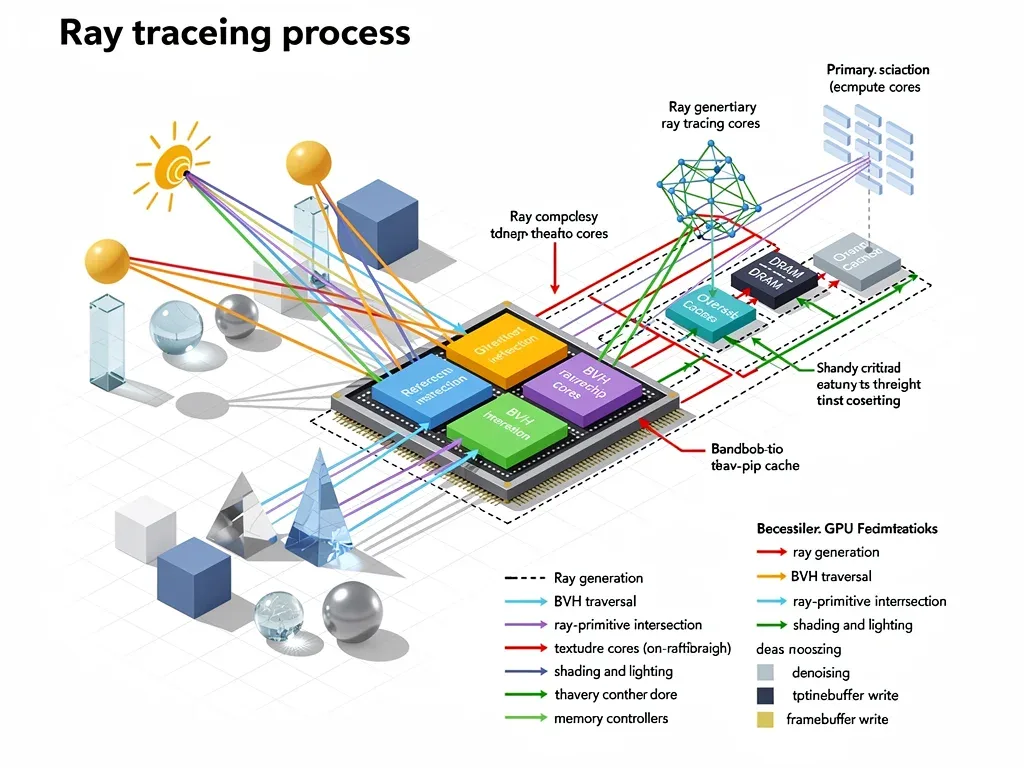
Simulating light involves complex algorithms that track millions of light rays per second. Each ray might bounce off multiple surfaces, each interaction requiring calculations for color, intensity, and direction. This iterative process is inherently parallel, making it suitable for GPU architectures, but the sheer volume of calculations can overwhelm even the most advanced mobile GPUs.
- Ray Generation: Creating millions of primary rays from the camera.
- Intersection Testing: Determining where each ray hits geometry in the scene.
- Shading and Bouncing: Calculating light interactions at the intersection point and generating secondary rays.
- Denoising: Cleaning up the inherent noise from stochastic ray tracing.
The result is a beautiful image, but one that requires immense processing power, leading directly to the significant frame rate reductions observed in real-world mobile gaming scenarios. Understanding this fundamental challenge is the first step toward appreciating the need for careful optimization.
The 45% Frame Rate Drop: Unpacking the Performance Hit
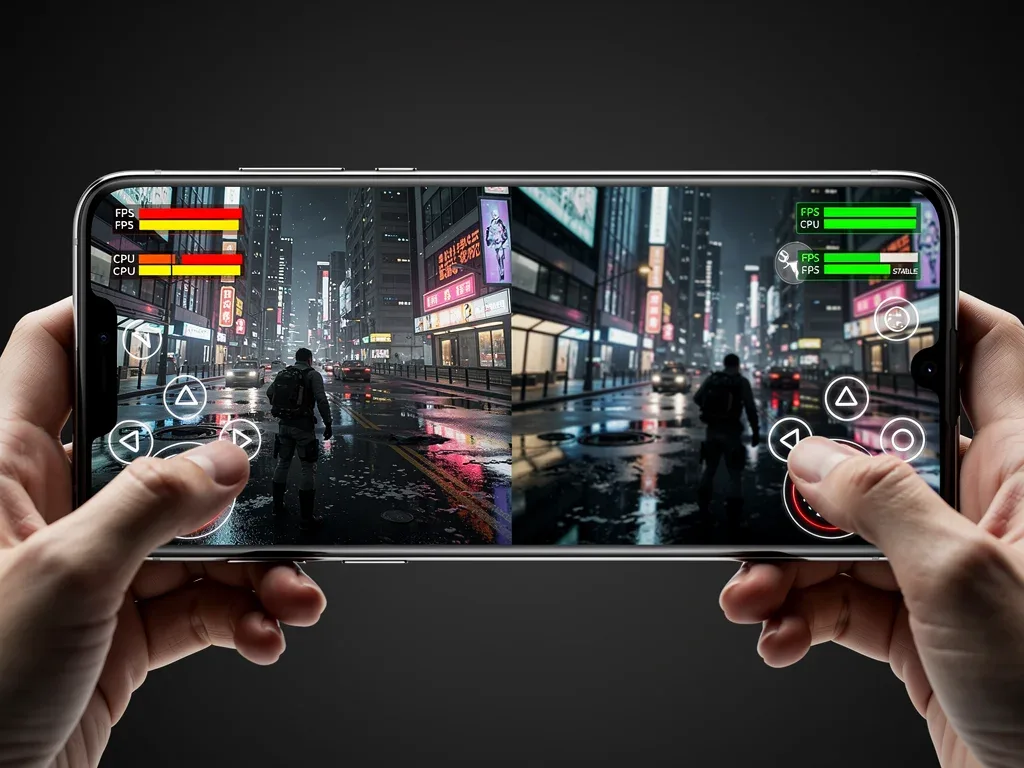
The reported 45% frame rate drop when enabling ray tracing on mobile devices isn't an arbitrary number; it's a direct consequence of the immense computational overhead. This reduction can transform a smooth 60 frames per second (FPS) experience into a choppy 33 FPS, making competitive or fast-paced games nearly unplayable.
Several factors contribute to this dramatic performance hit. Mobile GPUs, while powerful for their size, have fewer execution units and less memory bandwidth compared to their desktop counterparts. Ray tracing algorithms are memory-intensive, constantly accessing and updating complex scene data structures like Bounding Volume Hierarchies (BVHs).
Memory Bandwidth and Latency
One of the primary bottlenecks for mobile ray tracing performance is memory bandwidth. Ray tracing requires rapid access to large amounts of geometric and texture data. Mobile SoCs often share memory bandwidth between the CPU, GPU, and other components, leading to contention. High latency in memory access can cause the GPU to stall, waiting for data, which directly translates to lower frame rates.
Furthermore, the thermal constraints of mobile devices mean that sustained high performance is difficult to achieve. When the SoC heats up, it throttles performance to prevent damage, further exacerbating frame rate drops. This thermal throttling is particularly noticeable during extended gaming sessions with ray tracing enabled.
The 45% drop is an average, and actual figures can vary based on the specific game, the complexity of the scene, and the mobile hardware. Games with highly reflective surfaces or numerous light sources will see even more significant performance degradation. Developers must carefully balance visual fidelity with performance targets, especially when aiming for a broad audience of mobile devices.
The State of Mobile Hardware in 2026: What to Expect
By 2026, mobile hardware will have made significant strides, but fundamental limitations will persist. We can anticipate more powerful GPUs with increased raw compute capabilities and improved ray tracing acceleration units. Chip manufacturers like Qualcomm, MediaTek, and Apple are continually pushing boundaries, integrating more specialized hardware to handle complex graphical tasks.
However, the laws of physics and economics dictate that mobile devices will always operate within tighter power and thermal envelopes than desktop PCs. This means that while ray tracing will become more viable, it won't be a 'free' upgrade. Optimizations will remain crucial, and users will still need to make choices about graphical settings.
Advances in Mobile GPU Architectures
- Dedicated Ray Tracing Cores: More efficient and numerous RT cores integrated into mobile GPUs.
- Improved Memory Subsystems: Wider memory buses and faster LPDDR standards to mitigate bandwidth bottlenecks.
- Advanced Cooling Solutions: More sophisticated passive and active cooling mechanisms in premium devices.
- AI-Powered Upscaling: Technologies similar to DLSS or FSR becoming standard, rendering games at lower resolutions and upscaling them with AI to maintain visual quality and improve performance.
These advancements will undoubtedly make ray tracing more accessible and less performance-intensive. However, the goal for 2026 AAA mobile titles will likely be to offer a 'taste' of ray tracing rather than a full-blown, uncompromised implementation. Users will still need to manage expectations and understand the trade-offs involved.
The evolution of mobile hardware promises a more capable platform for advanced graphics, but the inherent challenges of power efficiency and thermal management will continue to shape how ray tracing is implemented and experienced on smartphones and tablets.
Recommended Graphic Presets for 2026 AAA Mobile Titles: Finding the Balance
Achieving a smooth and visually appealing experience in 2026 AAA mobile titles with ray tracing will hinge on intelligent graphic preset configurations. The goal is to strike a balance between visual fidelity and playable frame rates, avoiding the dreaded 45% performance drop. Full ray tracing might remain a demanding option for only the highest-end devices or for those willing to sacrifice frame rate significantly.
For most users, a hybrid approach will be key. Developers will likely offer granular control over ray tracing effects, allowing players to enable specific features like ray-traced shadows or reflections without activating a full suite of computationally expensive global illumination.
Optimizing Your Mobile Gaming Experience
When configuring your graphic presets for 2026 AAA mobile titles, consider the following recommendations:
- Ray-Traced Shadows (Medium): Often provides a significant visual upgrade without the extreme cost of full global illumination. Set quality to medium for a good balance.
- Ray-Traced Reflections (Low/Medium): Can add depth to environments, especially on water or metallic surfaces. Limit reflection quality and distance for better performance.
- Global Illumination (Off/Low): This is typically the most demanding ray tracing feature. Keep it off or at its lowest setting unless you have a top-tier device and can tolerate lower frame rates.
- Upscaling Technology (Enabled): Utilize any available AI-powered upscaling (e.g., FSR Mobile, custom vendor solutions). This renders the game at a lower internal resolution and intelligently scales it up, providing a near-native visual quality at much higher frame rates.
- Texture Quality (High): Textures are less performance-intensive than ray tracing and significantly impact visual richness. Set to high if your device has ample VRAM.
- Shadow Quality (Medium/High for Rasterized): If ray-traced shadows are too demanding, opt for high-quality rasterized shadows.
- Anti-Aliasing (Medium): TAA (Temporal Anti-Aliasing) is usually a good balance between visual smoothness and performance.
By carefully selecting these settings, players can enjoy the benefits of enhanced realism that ray tracing offers without crippling their device's performance. The key is to experiment and find the sweet spot that suits your specific device and game.
The Developer's Role: Smart Implementation of Ray Tracing
Game developers play a pivotal role in making ray tracing a viable feature on mobile. It's not enough for hardware to advance; software must be optimized to leverage these capabilities efficiently. Smart implementation involves more than just flipping a switch; it requires a deep understanding of mobile hardware constraints and creative solutions to deliver stunning visuals without prohibitive performance costs.
One common strategy is selective ray tracing, where only certain elements or effects are ray-traced. For instance, a game might use ray tracing for primary character reflections but rely on traditional rasterization for environmental lighting. This hybrid rendering approach allows developers to highlight key visual elements with ray tracing while maintaining performance for the broader scene.
Techniques for Optimized Mobile Ray Tracing
- Hybrid Rendering: Combining ray tracing for specific effects (reflections, shadows) with traditional rasterization for others.
- Ray Tracing Denoising: Utilizing advanced denoising algorithms, often AI-accelerated, to reduce the number of rays needed per pixel, thus lowering computational load.
- Temporal Reconstruction: Reusing ray tracing data from previous frames to reduce the workload in the current frame.
- Adaptive Quality: Dynamically adjusting ray tracing quality based on scene complexity or current frame rate targets.
- Mobile-Specific Ray Tracing APIs: Leveraging APIs optimized for mobile GPU architectures to maximize efficiency.
Developers are also increasingly relying on sophisticated game engines that abstract away much of the complexity, providing tools and pipelines specifically designed for mobile ray tracing. This allows them to focus on artistic vision while the engine handles the underlying technical challenges. The future of mobile ray tracing performance relies heavily on this collaborative effort between hardware manufacturers and game developers.
Future Outlook: The Evolution of Mobile Ray Tracing
The journey of ray tracing on mobile is still in its early stages, but the trajectory is clear: it's here to stay and will continue to evolve. By 2026 and beyond, we can expect a more seamless integration of ray tracing into mobile gaming experiences. The initial significant performance penalties will gradually lessen as hardware matures and software optimizations become more sophisticated.
We'll likely see ray tracing become a standard feature in high-end mobile SoCs, with dedicated hardware becoming more powerful and efficient. The emphasis will shift from simply enabling ray tracing to delivering a high-quality, performant experience across a wider range of devices. This means that while a 45% frame rate drop might be common today, future iterations will aim to reduce that impact significantly.
Innovations on the Horizon
Expect innovations in several key areas:
- Neural Graphics: The convergence of AI and graphics, where AI models assist in rendering complex lighting and shadows, potentially reducing the need for brute-force ray tracing.
- Cloud-Based Ray Tracing: Offloading some of the heaviest ray tracing computations to cloud servers, streaming the results back to mobile devices. This could enable desktop-class visuals on mobile without local hardware strain.
- Standardized Mobile Ray Tracing APIs: Broader adoption and refinement of APIs like Vulkan Ray Tracing, ensuring better cross-platform compatibility and optimization.
- Power-Efficient Ray Tracing Algorithms: Research into new algorithms that achieve similar visual quality with fewer computational resources.
The future of mobile ray tracing performance is bright, promising increasingly immersive and realistic mobile gaming experiences. While the initial hurdles are substantial, the continuous innovation in both hardware and software will pave the way for a new era of visual fidelity on our handheld devices. The goal is to make ray tracing an enhancement that complements, rather than compromises, the mobile gaming experience.
| Key Point | Brief Description |
|---|---|
| Ray Tracing Impact | Causes up to 45% frame rate drops on mobile due to high computational demands for realistic light simulation. |
| Mobile Hardware 2026 | Expected to improve with dedicated RT cores and better memory, but power/thermal limits remain. |
| Recommended Presets | Hybrid approach: medium ray-traced shadows/reflections, off/low global illumination, enabled upscaling. |
| Developer Role | Crucial for smart implementation via hybrid rendering, denoising, and adaptive quality to optimize performance. |
Frequently Asked Questions About Mobile Ray Tracing
Why does ray tracing affect mobile frame rates so much?▼Ray tracing is computationally intensive, simulating light paths for realistic reflections and shadows. Mobile hardware has limited power, thermal capacity, and memory bandwidth compared to desktops, leading to significant performance drops when these complex calculations are performed on-device.
Will mobile hardware in 2026 eliminate these performance issues?▼While 2026 mobile hardware will be significantly more powerful with better ray tracing acceleration, fundamental power and thermal constraints will remain. Performance will improve, but complete elimination of frame rate drops from full ray tracing is unlikely; optimizations will still be necessary.
What graphic presets are recommended for 2026 AAA mobile games with ray tracing?▼For a balanced experience, prioritize medium ray-traced shadows and reflections, keep global illumination off or low, and always enable AI upscaling technology. High texture quality and medium anti-aliasing can also enhance visuals without crippling performance.
What is hybrid rendering in the context of mobile ray tracing?▼Hybrid rendering combines ray tracing for specific, visually impactful effects (like reflections on key objects) with traditional rasterization for other parts of the scene. This method allows developers to achieve enhanced realism where it matters most, while managing the overall computational load for better performance.
How will AI upscaling technologies help mobile ray tracing?▼AI upscaling renders games at a lower internal resolution and then uses artificial intelligence to intelligently reconstruct the image to a higher resolution. This significantly reduces the rendering workload, allowing for higher frame rates even with ray tracing enabled, providing a near-native visual experience with improved performance.
Conclusion
The allure of ray tracing on mobile is undeniable, promising desktop-level visual fidelity in the palm of your hand. However, as demonstrated by the significant 45% frame rate drops, this technology comes with substantial performance costs due to the inherent limitations of mobile hardware. By 2026, advancements in mobile GPUs and specialized ray tracing cores will undoubtedly mitigate some of these challenges, but smart graphic preset management and optimized game development will remain crucial. Gamers will need to embrace a hybrid approach, selectively enabling ray-traced effects and leveraging AI upscaling to strike a balance between breathtaking visuals and smooth gameplay. The future of mobile ray tracing is not about simply turning it on, but about intelligently integrating it to enhance the mobile gaming experience without compromising playability.