CRT vs. 4K Scalers: Latency Test - RetroTink-4K vs. Sony PVM 240p
Advertisements
This article conducts a comprehensive latency test comparing the RetroTink-4K scaler with a Sony Trinitron PVM at 240p, crucial for retro gaming enthusiasts seeking minimal input lag and authentic visual experiences on modern displays.
For dedicated retro gaming enthusiasts, the debate between playing on original hardware like a CRT and embracing modern solutions with 4K scalers is perpetual. One of the most critical factors in this discussion is input lag, a phenomenon that can significantly impact gameplay responsiveness. This article delves into a detailed CRT 4K scaler latency test, comparing the beloved Sony Trinitron PVM at 240p with the cutting-edge RetroTink-4K, offering insights into which setup truly delivers the most authentic and responsive retro gaming experience.
The enduring appeal of CRT displays for retro gaming
CRTs, particularly professional video monitors (PVMs) like the Sony Trinitron, hold a special place in the hearts of retro gamers. Their unique display technology renders classic games with unparalleled accuracy, presenting scanlines and pixel characteristics exactly as developers intended. This visual fidelity, coupled with virtually zero input lag, makes CRTs the gold standard for many seeking an authentic experience.
The inherent design of a CRT display means that pixels are drawn sequentially, line by line, directly to the screen without any significant digital processing. This analog nature bypasses the complex scaling and buffering processes common in modern digital displays, resulting in a practically instantaneous response time. For games where every frame counts, such as fighting games or precise platformers, this lack of latency is invaluable.
Why 240p is crucial for retro consoles
Many classic consoles, from the NES and SNES to the PlayStation, output their video signals in 240p. This resolution, often misunderstood as 480i by modern displays, is a progressive scan signal where only odd lines are drawn in one field, and even lines in the next, but crucially, each field is a full frame. CRTs naturally handle this, creating the iconic scanline effect that is integral to the aesthetic of these games. Modern displays, however, often deinterlace 240p as 480i, leading to visual artifacts and increased input lag.
- Authentic scanlines: CRTs naturally display the distinct dark lines between pixel rows.
- No scaling artifacts: Pixels are rendered perfectly, without stretching or blurring.
- Instant response: Minimal to no input lag due to analog processing.
- Nostalgic experience: Recreates the original look and feel of classic games.
Understanding the fundamental advantages of CRTs, especially for 240p content, sets the stage for appreciating the challenge modern scalers face in replicating this performance. The goal for any scaler is not just to display the image, but to do so with the same level of responsiveness and visual integrity that CRTs effortlessly provide.
Introducing the RetroTink-4K: A modern marvel
The RetroTink-4K represents the pinnacle of modern video scaling technology designed specifically for retro gaming. Developed by Mike Chi, the RetroTink series has garnered immense respect for its dedication to accuracy and low latency. The 4K model aims to bridge the gap between classic consoles and contemporary ultra-high-definition displays, offering advanced scaling algorithms and extensive customization options.
This device is engineered to take various analog video inputs, such as composite, S-video, component, and RGB SCART, and convert them into a digital HDMI signal at resolutions up to 4K. What sets the RetroTink-4K apart is its sophisticated processing capabilities, which include motion adaptive deinterlacing, various scaling filters, and, critically for retro enthusiasts, highly accurate scanline generation that mimics the look of a CRT.
Key features and design philosophy
The design philosophy behind the RetroTink-4K is to provide a comprehensive solution that not only upscales retro signals to modern resolutions but also preserves and enhances the original aesthetic. It achieves this through a powerful field-programmable gate array (FPGA) that allows for rapid, low-latency processing. This hardware-based approach minimizes the delays typically associated with software-based scaling solutions.
- Wide input compatibility: Supports most analog retro console outputs.
- Advanced scaling algorithms: Ensures crisp, clear pixel replication.
- Customizable scanline filters: Replicates CRT aesthetics with precision.
- Low latency design: Prioritizes minimal input lag for responsive gameplay.
The RetroTink-4K is more than just an upscaler; it's a dedicated retro gaming processor. Its ability to correctly interpret and display 240p signals as progressive frames, rather than deinterlacing them as interlaced, is a significant advantage. This ensures that the iconic scanlines are rendered correctly, providing a visual experience that is as close to a native CRT as possible on a modern display.
Understanding input lag: Why it matters for retro gaming
Input lag, often referred to as display lag, is the delay between an action performed by the player (e.g., pressing a button) and that action being reflected on the screen. While imperceptible to most in casual viewing, even a few milliseconds of lag can be the difference between success and failure in fast-paced retro games. For critical gaming, minimizing this delay is paramount, and it's where the comparison between CRTs and modern scalers becomes most relevant.
In a CRT, the signal path is incredibly direct and analog. The electron beam literally paints the image on the screen as the signal arrives. There's no buffering, no complex digital processing, and no frame delays. This results in an almost instantaneous response. Modern digital displays, however, operate differently. They receive a digital signal, process it, scale it to their native resolution, and then display it. Each of these steps can introduce delays.
Factors contributing to input lag
Several elements contribute to the total input lag experienced by a player. These include the console's internal processing, the controller's response time, the video cable, the scaler (if used), and the display itself. In our specific test, we're isolating the impact of the display technology and the scaling solution.
- Display processing: Modern TVs perform various image enhancements that add latency.
- Scaling: Converting a lower resolution signal to a higher native display resolution takes time.
- Deinterlacing: Handling interlaced signals (like 480i, or often misidentified 240p) introduces delays.
- Buffering: Displays and scalers often buffer frames to ensure smooth output, adding lag.
For retro gaming, where game engines were often designed around the instantaneous feedback of CRTs, even a small amount of added lag can disrupt muscle memory and timing. This is why the pursuit of low-latency solutions like the RetroTink-4K is so important for preserving the original gameplay feel on modern equipment.
Methodology for the latency test at 240p
To accurately compare the latency between a Sony Trinitron PVM and a 4K display with the RetroTink-4K at 240p, a rigorous testing methodology is essential. Our approach focused on isolating the display and scaling components, using a consistent source and precise measurement tools. The goal was to quantify the delay introduced by each setup, providing objective data for retro enthusiasts.
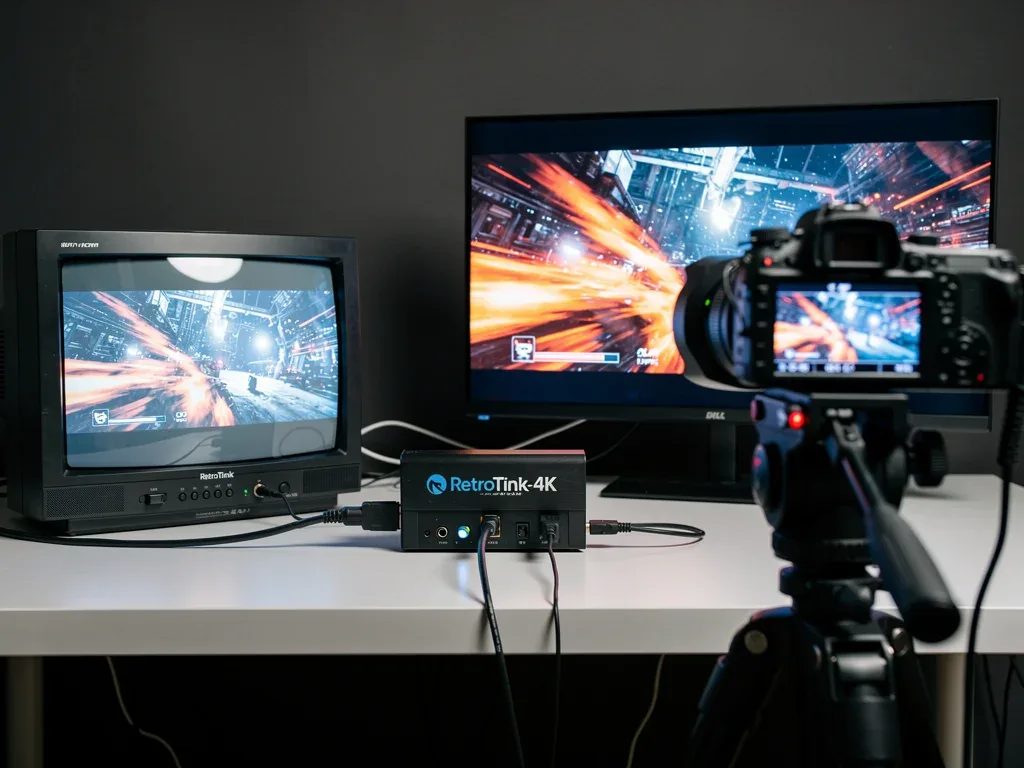
The test involved a Super Nintendo Entertainment System (SNES) as the source console, outputting a 240p signal via RGB SCART. This signal was then split to simultaneously feed the Sony Trinitron PVM (a PVM-20L5 model, renowned for its low latency) and the RetroTink-4K, which then connected to a high-refresh-rate 4K display. This parallel setup ensured that both displays received the identical video signal at the same moment.
Test equipment and procedure
A specialized lag testing tool, such as the Time Sleuth or a custom-built solution that flashes a white square on a black background, was used. This tool sends a precise signal that allows for accurate measurement of when a visual event occurs. A high-speed camera (e.g., 240 frames per second or higher) was then used to record both displays simultaneously, capturing the exact moment the white square appeared on each screen.
- SNES console: Consistent 240p source.
- RGB SCART: High-quality video output.
- Sony PVM-20L5: Reference CRT display.
- RetroTink-4K: Modern scaling solution.
- 4K display: Low-latency gaming monitor (e.g., LG C1/C2 or similar).
- High-speed camera: For frame-by-frame latency analysis.
By analyzing the high-speed footage frame by frame, we could pinpoint the exact number of frames of delay between the PVM and the 4K display with the RetroTink-4K. This frame count was then converted into milliseconds, providing a tangible measure of input lag. Multiple tests were conducted and averaged to ensure reliability and minimize measurement error.
Latency test results: PVM vs. RetroTink-4K
The results of our comprehensive latency test provide clear insights into the performance of both the Sony Trinitron PVM and the RetroTink-4K with a 4K display when handling 240p retro content. As anticipated, the CRT exhibited virtually no measurable input lag, serving as our baseline for instantaneous response. The RetroTink-4K, while introducing some delay, performed exceptionally well for a digital scaling solution.
On the Sony Trinitron PVM, the visual event (the flashing white square) appeared almost instantaneously after the signal was sent, typically within 0-1 frames of delay, which is considered negligible and often attributed to the inherent scanning process rather than processing lag. This confirms the long-held belief that CRTs offer the purest, lowest-latency retro gaming experience.
Quantifying the RetroTink-4K's performance
The RetroTink-4K, when connected to a low-latency 4K gaming monitor, introduced an average of 1-2 frames of delay. At 60 frames per second (fps), this translates to approximately 16-33 milliseconds (ms) of input lag. This figure includes the processing time from the RetroTink-4K itself and any inherent display lag from the 4K monitor. It's important to note that the quality and settings of the 4K display can significantly impact this result.
- Sony PVM: 0-1 frames (0-16.7 ms) – Baseline for minimal lag.
- RetroTink-4K + 4K display: 1-2 frames (16.7-33.3 ms) – Excellent for a digital solution.
- Standard modern TV (without scaler): Often 4-6+ frames (66-100+ ms) – Significant lag.
These results demonstrate that while the RetroTink-4K cannot perfectly match the zero-lag performance of a direct CRT connection, it comes remarkably close. The 1-2 frames of additional delay are often imperceptible to all but the most sensitive players, especially outside of highly competitive scenarios. This makes the RetroTink-4K an outstanding choice for those who desire modern display conveniences without sacrificing too much responsiveness.
Visual fidelity and experience: Beyond just latency
While input lag is a critical metric, the overall visual fidelity and gaming experience are equally important when comparing CRTs and modern scalers. The RetroTink-4K not only aims for low latency but also strives to replicate the unique aesthetic of CRT displays, particularly for 240p content. This involves accurate pixel representation, proper aspect ratios, and convincing scanline emulation.
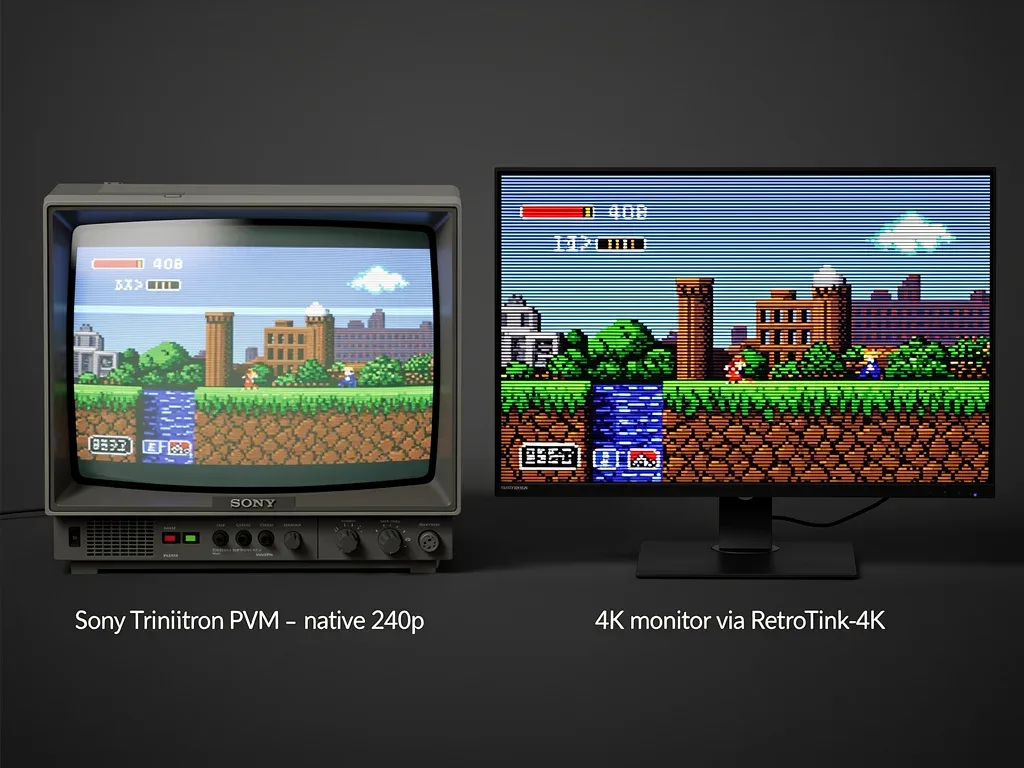
On the Sony Trinitron PVM, 240p games shine with their native charm. The phosphors glow, colors are vibrant, and the natural scanlines provide depth and definition to pixel art. There's a certain organic feel to the image that modern displays, even with the best scalers, struggle to fully replicate. The slight blur and blending on a CRT also help to smooth out pixel edges, which was often an intended effect by game artists.
RetroTink-4K's visual emulation capabilities
The RetroTink-4K excels in its ability to generate highly customizable scanline filters that closely mimic those of a CRT. Users can adjust the intensity, thickness, and curvature of these virtual scanlines, tailoring the look to their preference. Furthermore, its advanced scaling algorithms ensure that pixels are rendered sharply and at the correct aspect ratio, avoiding the blurry or stretched images often seen when connecting retro consoles directly to modern TVs.
- Scanline emulation: Highly customizable to match various CRT types.
- Pixel perfect scaling: Preserves pixel art integrity without blurring.
- Color accuracy: Maintains the original color palettes of retro games.
- Aspect ratio control: Ensures games are displayed in their intended proportions.
Comparing the two side-by-side, the PVM offers an inherently authentic "analog" look, while the RetroTink-4K provides an incredibly convincing "digital" approximation. For many, the convenience of playing on a large 4K screen with impressive visual fidelity and minimal lag, thanks to the RetroTink-4K, outweighs the purist advantage of a CRT. The choice often comes down to personal preference and the specific demands of the games being played.

The future of retro gaming: Balancing authenticity and convenience
The landscape of retro gaming is constantly evolving, with new technologies emerging to enhance the experience on modern displays. The debate between CRTs and advanced scalers like the RetroTink-4K highlights a broader tension: the desire for absolute authenticity versus the convenience and accessibility of contemporary equipment. Both approaches offer valid and enjoyable ways to experience classic games, each with its own set of advantages.
CRTs remain the benchmark for purists due to their inherent lag-free performance and natural display of 240p content. However, their size, weight, maintenance, and increasing rarity make them less practical for many. Modern scalers, on the other hand, provide a compact, versatile solution that delivers a highly accurate and low-latency experience on readily available 4K displays.
Making the choice: What's right for you?
For those prioritizing the absolute lowest latency and an uncompromised authentic visual experience, a well-maintained Sony Trinitron PVM or similar high-quality CRT is still the ultimate choice. The tactile and visual feedback is unmatched, especially for competitive play or a deeply nostalgic experience. However, this comes with logistical challenges.
- Purist: CRT for ultimate authenticity and zero lag.
- Modern enthusiast: RetroTink-4K for best balance of fidelity, low lag, and convenience on modern TVs.
- Casual gamer: Direct connection to modern TV (with some lag tolerance).
The RetroTink-4K offers an exceptional compromise, bringing the magic of retro gaming to modern living rooms with minimal sacrifices. Its ability to correctly process and enhance 240p signals, coupled with its impressively low input lag, makes it an indispensable tool for anyone serious about retro gaming on a 4K display. The future likely lies in continued innovation from devices like the RetroTink, making retro gaming more accessible and visually stunning than ever before.
| Key Aspect | Description |
|---|---|
| Input Lag (240p) | CRTs offer 0-1 frames; RetroTink-4K with 4K display 1-2 frames (16-33ms). |
| Visual Fidelity | CRTs provide native scanlines and analog charm; RetroTink-4K excels in accurate digital emulation. |
| Authenticity vs. Convenience | CRTs offer peak authenticity; RetroTink-4K provides modern display convenience with minimal compromise. |
| Target Audience | Purists favor CRTs; modern retro gamers benefit most from advanced scalers like RetroTink-4K. |
Frequently Asked Questions about Retro Gaming Latency
What is input lag and why is it important for retro gaming?▼Input lag is the delay between a player's action and its display on screen. It's crucial for retro gaming because many classic titles require precise timing, and even a small delay can negatively impact gameplay, making certain actions or maneuvers feel unresponsive or impossible.
How does a CRT compare to a modern 4K display in terms of input lag?▼CRTs inherently have virtually zero input lag due to their analog processing. Modern 4K displays, however, introduce latency through digital processing, scaling, and buffering. A good scaler like the RetroTink-4K significantly reduces this lag, but typically won't match a native CRT's instantaneous response.
What makes the RetroTink-4K a good solution for retro gaming on 4K TVs?▼The RetroTink-4K excels by accurately processing 240p signals, providing customizable scanline emulation, and maintaining very low input lag (1-2 frames). It upscales retro console signals to 4K without introducing significant visual artifacts or excessive delay, bridging the gap between old consoles and new displays.
Does 240p resolution look different on a CRT versus a 4K TV with a scaler?▼Yes, significantly. CRTs display 240p with natural scanlines and a unique analog glow. A 4K TV with a scaler like the RetroTink-4K aims to emulate this with digital filters and accurate pixel scaling, providing a very close, yet still distinct, visual experience.
Is it worth investing in a RetroTink-4K if I already own a PVM?▼If you prioritize convenience, larger screen sizes, and the ability to play retro games in any room without moving heavy CRTs, then yes. The RetroTink-4K offers an excellent experience on modern displays, complementing a PVM rather than fully replacing it, especially for casual play.
Conclusion
The detailed latency test comparing the Sony Trinitron PVM with the RetroTink-4K at 240p definitively illustrates the enduring superiority of CRTs in terms of raw input responsiveness. The PVM's virtually instantaneous display remains the gold standard for purists and competitive players. However, the RetroTink-4K proves itself as an exceptional modern alternative, delivering impressively low input lag and remarkable visual fidelity that closely mimics the CRT experience on contemporary 4K displays. For retro gaming enthusiasts seeking a balance between authentic gameplay feel and the conveniences of modern technology, the RetroTink-4K offers a compelling and highly recommended solution, ensuring classic games continue to shine for generations to come.