Optimize Your PC for 144Hz Gaming: 2026 Configuration Guide
Advertisements
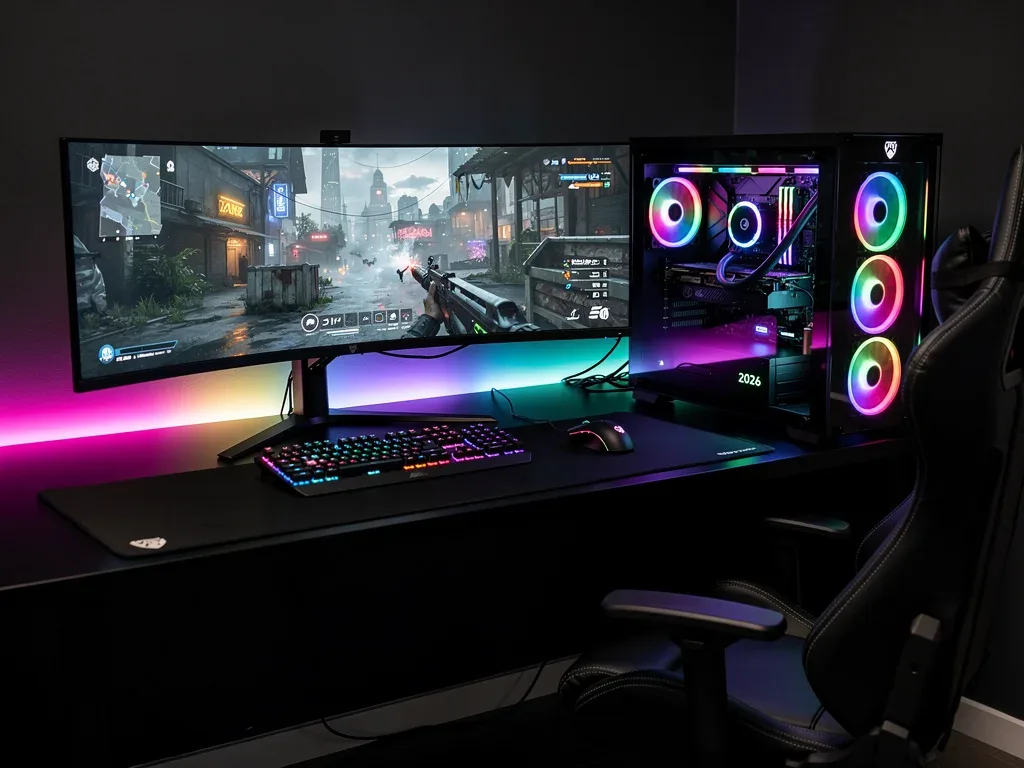
Achieving optimal 144Hz gaming performance in 2026 requires a balanced approach to hardware selection, software configuration, and system tuning, ensuring a fluid and immersive experience.
The pursuit of buttery-smooth gameplay at high refresh rates has become a cornerstone of the modern gaming experience. If you’re aiming for the pinnacle of visual fluidity, specifically 144 frames per second (fps) on a 144Hz monitor, then optimizing your PC gaming setup for 144Hz performance: a step-by-step 2026 configuration guide is essential. This guide will navigate you through the critical components, software tweaks, and advanced settings necessary to achieve and maintain that coveted high-refresh-rate gameplay, ensuring every frame counts and every motion is rendered with breathtaking clarity. Get ready to elevate your gaming to an unparalleled level of responsiveness and immersion.
Understanding 144Hz and Its Impact on Gaming
Before diving into specific configurations, it’s crucial to grasp what 144Hz truly means for your gaming experience. A 144Hz monitor refreshes its image 144 times per second, significantly more than the standard 60Hz. This higher refresh rate translates directly into smoother motion, reduced input lag, and a more responsive feel, particularly in fast-paced games where every millisecond matters. The difference, once experienced, is often described as transformative, making it difficult to go back to lower refresh rates.
The impact extends beyond mere visual smoothness. Higher refresh rates can contribute to improved reaction times and better target tracking, offering a competitive edge in esports titles. However, to fully utilize a 144Hz display, your PC must be capable of consistently rendering frames at or above 144fps. This is where optimization becomes paramount, as a mismatch between your monitor’s refresh rate and your PC’s frame rate can lead to screen tearing or stuttering, negating the benefits of high refresh rate gaming.
The Visual Advantage of High Refresh Rates
The human eye’s ability to perceive frames per second is a subject of ongoing debate, but the tangible benefits of 144Hz are widely accepted by gamers. The reduction in motion blur and ghosting is immediately apparent, making fast-moving objects appear much clearer. This clarity is not just cosmetic; it provides a more accurate representation of the game world, allowing for better decision-making and enhanced immersion.
- Reduced Motion Blur: Objects in motion appear sharper and more defined.
- Smoother Animations: Character movements and environmental transitions are fluid.
- Lower Input Lag: The delay between your input and the on-screen action is minimized.
- Competitive Edge: Enhanced visual feedback can improve reaction times in competitive titles.
In essence, 144Hz gaming isn’t just about a number; it’s about a fundamentally superior visual and interactive experience. It removes many of the visual limitations that can hinder a player’s performance and enjoyment. Understanding this foundational benefit underpins every hardware and software decision you’ll make in optimizing your setup.
Core Hardware Components for 144Hz Gaming in 2026
Achieving consistent 144fps in modern titles by 2026 demands a powerful and balanced hardware configuration. The synergy between your CPU, GPU, RAM, and storage is crucial, as a bottleneck in any single component can severely limit overall performance. Investing in future-proof components is key to ensuring your system remains capable for years to come.
The landscape of PC hardware evolves rapidly, and by 2026, we anticipate even more demanding games. Therefore, our recommendations lean towards robust, high-performance parts that can handle current and upcoming titles at high frame rates and resolutions. Prioritizing quality and compatibility will save you headaches and upgrades down the line.
Graphics Card (GPU): The Heart of High FPS
The graphics card is arguably the most critical component for 144Hz gaming. By 2026, expect GPUs to have significantly advanced, offering unparalleled ray tracing capabilities and raw rasterization power. For 144Hz at 1080p, a high-mid-range GPU will likely suffice, but for 1440p or 4K at 144Hz, a top-tier enthusiast-grade GPU is non-negotiable. Look for models with ample VRAM (16GB+ for 1440p/4K) and advanced cooling solutions.
- NVIDIA GeForce RTX 50 Series (or equivalent): Aim for the RTX 5070/5080 or higher.
- AMD Radeon RX 8000 Series (or equivalent): Consider the RX 8800 XT/8900 XT or higher.
- VRAM: 12GB minimum for 1080p 144Hz, 16GB+ for 1440p and 4K 144Hz.
Processor (CPU): The Orchestrator
While the GPU handles most of the graphical heavy lifting, a powerful CPU is essential to feed frames to the GPU quickly and efficiently, preventing bottlenecks. By 2026, multi-core performance will be even more critical, especially for modern games that leverage multiple threads. A CPU with high single-core clock speeds and a healthy core/thread count will be ideal.
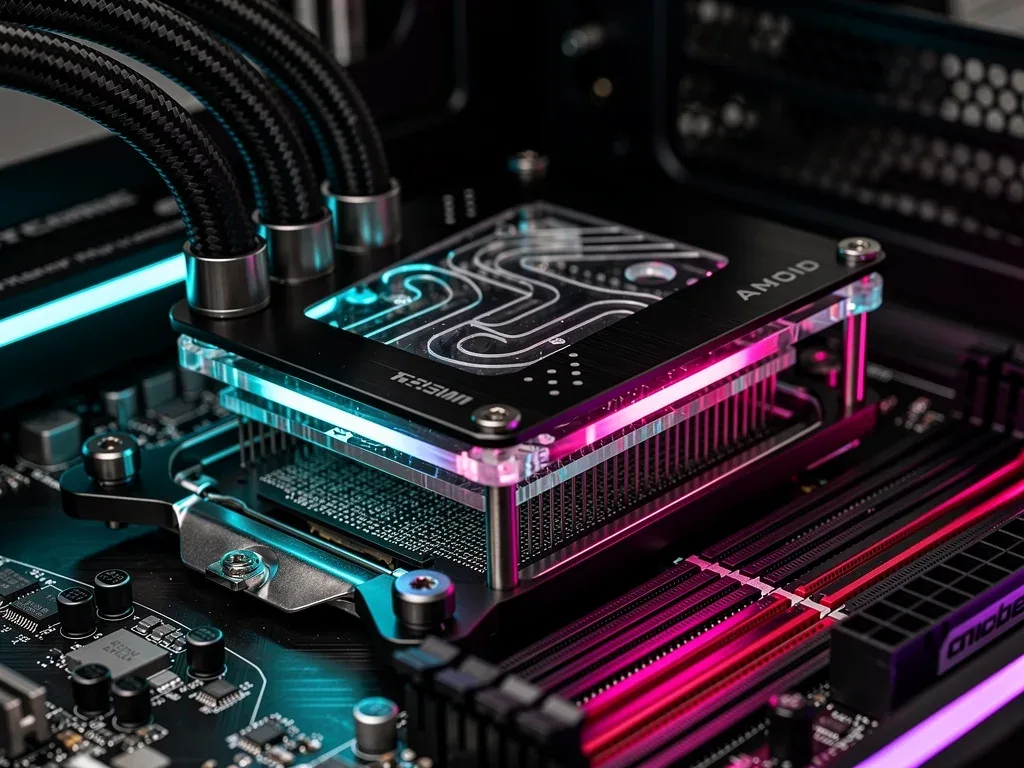
- Intel Core i7/i9 (16th Gen or newer): Focus on models with high clock speeds and efficient core architectures.
- AMD Ryzen 7/9 (Zen 6 or newer): Look for CPUs with strong multi-core performance and gaming optimizations.
- Cooling: A robust air cooler or, ideally, an AIO liquid cooler is recommended to maintain optimal temperatures.
RAM and Storage: Speed and Capacity
RAM (Random Access Memory) impacts overall system responsiveness and game loading times. For 144Hz gaming in 2026, 32GB of DDR5 RAM running at high speeds (6000MHz+) is the sweet spot. This provides ample headroom for demanding games and background applications. Storage, specifically NVMe SSDs, is crucial for rapid game loading and texture streaming.
- RAM: 32GB DDR5 (6000MHz+ CL30/CL32) is highly recommended.
- Primary Storage: 1TB NVMe PCIe Gen5 SSD for operating system and primary games.
- Secondary Storage: Additional NVMe PCIe Gen4/Gen5 SSDs or high-capacity SATA SSDs for a larger game library.
Selecting these core components carefully forms the foundation of your 144Hz gaming rig. Each piece plays a vital role, and balancing their capabilities is key to unlocking the full potential of your high-refresh-rate monitor. Remember to check compatibility between all components, especially regarding motherboard socket types and power supply wattage, to ensure a smooth build process.
Optimizing Your Monitor and Display Settings
Even with top-tier hardware, a 144Hz monitor won’t deliver its full potential without proper configuration. Incorrect display settings can lead to a suboptimal experience, negating the benefits of your powerful PC. This section focuses on ensuring your monitor is correctly set up to display at its advertised refresh rate and leveraging adaptive sync technologies for tear-free gameplay.
The goal is to achieve a seamless visual output where every frame rendered by your GPU is displayed on your monitor without interruption or delay. This involves checking basic display settings, enabling advanced features, and understanding the nuances of adaptive sync to match your monitor’s capabilities with your PC’s output.
Enabling 144Hz in Windows
The first and most fundamental step is to ensure Windows is actually set to output at 144Hz. Often, monitors default to 60Hz out of the box, requiring a manual adjustment. This is a quick process but is frequently overlooked.
- Right-click on desktop > Display settings > Advanced display settings.
- Choose your 144Hz monitor > Display adapter properties for Display [X].
- Monitor tab > Screen refresh rate > Select 144Hz.
Adaptive Sync Technologies: G-Sync and FreeSync
Adaptive sync technologies like NVIDIA G-Sync and AMD FreeSync are game-changers for high-refresh-rate monitors. They synchronize your monitor’s refresh rate with your GPU’s frame rate, eliminating screen tearing and reducing stuttering, even when your frame rate fluctuates below 144fps. This results in incredibly smooth and fluid gameplay.
- NVIDIA G-Sync: Requires a compatible NVIDIA GPU and a G-Sync certified monitor.
- AMD FreeSync: Works with compatible AMD GPUs and FreeSync monitors (often more affordable).
- G-Sync Compatible (Adaptive Sync): Many FreeSync monitors are now compatible with NVIDIA GPUs via Adaptive Sync.
Make sure to enable G-Sync or FreeSync in your GPU’s control panel (NVIDIA Control Panel or AMD Radeon Software) and on your monitor’s OSD (On-Screen Display) settings. This synchronization is key to a truly optimized 144Hz experience, providing visual fidelity without the distractions of tearing or choppiness. Properly configured, your monitor will work in perfect harmony with your powerful gaming rig.
Operating System and Driver Optimization for 2026
Beyond hardware, a well-tuned operating system and up-to-date drivers are crucial for maximizing your PC’s 144Hz gaming performance. Outdated drivers or inefficient system settings can introduce bottlenecks, leading to lower frame rates and instability. By 2026, operating systems will likely be even more sophisticated, but the core principles of optimization remain.
This section delves into the essential software side of your setup, ensuring that your Windows installation and all relevant drivers are configured for peak gaming efficiency. A clean and optimized software environment allows your hardware to perform at its best, translating directly into higher and more stable frame rates.
Keeping Drivers Up-to-Date
Graphics drivers are the most important for gaming performance. NVIDIA and AMD regularly release new drivers that include performance optimizations for the latest games and bug fixes. Keeping these drivers current is non-negotiable for anyone serious about gaming at 144Hz.
- Graphics Drivers: Download directly from NVIDIA or AMD’s official websites.
- Chipset Drivers: Update from your motherboard manufacturer’s website or Intel/AMD.
- Monitor Drivers: While less common, some monitors benefit from specific drivers.
Windows Settings for Gaming
Windows offers several settings that can impact gaming performance. Disabling unnecessary background processes and features can free up system resources, allowing your games to run more smoothly. By 2026, Windows will likely have even more gaming-specific features, but current optimizations are a good starting point.
- Game Mode: Ensure Windows Game Mode is enabled (Settings > Gaming > Game Mode).
- Power Plan: Set your power plan to “High Performance” or “Ultimate Performance.”
- Disable Background Apps: Turn off unnecessary apps running in the background (Settings > Privacy > Background apps).
- Notifications: Disable notifications during gaming sessions.
Regularly checking for OS updates and driver releases will keep your system running optimally. A well-maintained software environment is just as important as powerful hardware in achieving and sustaining 144Hz performance. This proactive approach minimizes potential issues and ensures your gaming sessions are as smooth as possible, allowing you to fully appreciate the high refresh rate experience.
In-Game Settings and Graphics Optimization
Once your hardware and system software are optimized, the final frontier for achieving consistent 144fps lies within the game settings themselves. Even with a powerful rig, blindly maxing out every graphical option can push your system beyond its limits, leading to frame drops. The art of in-game optimization is finding the perfect balance between visual fidelity and frame rate.
This section will guide you through the most impactful in-game settings that influence performance, helping you prioritize those that offer the best visual return for the lowest performance cost. The goal is to maintain that coveted 144fps target while still enjoying a visually rich gaming experience, making the most of your 144Hz monitor.
Key Graphics Settings to Adjust
Different graphical settings have varying impacts on performance. Some, like shadow quality or anti-aliasing, can be incredibly demanding, while others, such as texture quality, might have a lesser effect if your GPU has ample VRAM. Understanding which settings to tweak first is crucial for efficient optimization.
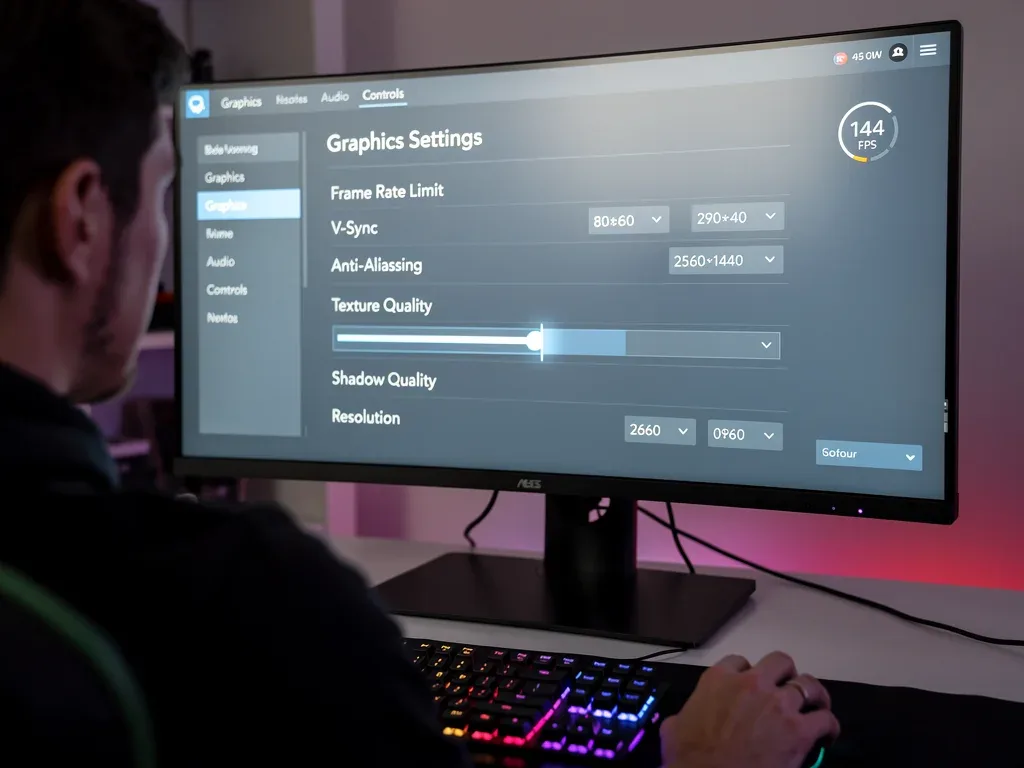
- Resolution: Always prioritize native resolution for sharpness; adjust other settings around it.
- Texture Quality: Set to High/Ultra if you have sufficient VRAM (12GB+).
- Shadow Quality: Often a significant performance hit; consider lowering to Medium or High.
- Anti-aliasing: MSAA is very demanding; TAA or FXAA are often better performance-wise.
- Volumetric Clouds/Fog: Can be very taxing; lowering these can yield significant FPS gains.
Disabling V-Sync and Leveraging Adaptive Sync
While V-Sync (Vertical Synchronization) aims to prevent screen tearing, it can introduce input lag and cap your frame rate at your monitor’s refresh rate. If you’re using G-Sync or FreeSync, V-Sync should generally be disabled in-game and managed by your adaptive sync technology in the GPU control panel. This ensures tear-free visuals without the drawbacks of traditional V-Sync.
Additionally, consider using in-game frame rate limiters or external tools like RivaTuner Statistics Server (RTSS) to cap your frame rate slightly below your monitor’s maximum refresh rate (e.g., 141-143fps for a 144Hz monitor). This can further reduce input lag and ensure adaptive sync remains active, providing the smoothest possible experience. Experiment with different settings in each game, as optimal configurations can vary widely, to truly optimize your PC gaming setup for 144Hz performance.
Advanced Tweaks and Future-Proofing for 2026
To truly maximize your 144Hz gaming experience and ensure your setup remains competitive into 2026 and beyond, some advanced tweaks and future-proofing considerations are essential. This goes beyond basic component selection and delves into system maintenance, overclocking, and strategic upgrade planning.
The goal is not just to hit 144fps today but to sustain it as game demands increase and new technologies emerge. Proactive maintenance and thoughtful upgrades will extend the lifespan and performance ceiling of your gaming rig, allowing you to enjoy high-refresh-rate gaming for years to come without constant rebuilds.
Overclocking Your CPU and GPU
Overclocking can provide a noticeable performance boost, squeezing extra frames out of your existing hardware. Both CPUs and GPUs can be safely overclocked with proper cooling and knowledge. By 2026, manufacturers will likely offer even more user-friendly overclocking tools, but the principles remain the same.
- CPU Overclocking: Requires a Z-series Intel motherboard or an AMD B/X series motherboard. Use tools like Intel XTU or AMD Ryzen Master.
- GPU Overclocking: Use software like MSI Afterburner or EVGA Precision X1. Focus on core clock, memory clock, and power limits.
- Stability Testing: Always stress test your system after overclocking to ensure stability.
Maintaining Your System
A well-maintained PC performs better and lasts longer. Regular cleaning, thermal paste replacement, and software hygiene are crucial for sustained performance, especially when pushing your system to 144fps. Dust accumulation can lead to higher temperatures and thermal throttling, reducing frame rates.
- Dust Cleaning: Regularly clean dust from fans, heatsinks, and case filters.
- Thermal Paste: Consider reapplying CPU thermal paste every 2-3 years for optimal cooling.
- Disk Cleanup: Periodically run disk cleanup and defragment (for HDDs, not SSDs).
- Software Hygiene: Uninstall unused programs, manage startup applications.
Future-proofing also involves keeping an eye on upcoming hardware releases and technological advancements. While you can’t always predict the future, understanding trends in CPU core counts, GPU VRAM requirements, and storage speeds will help you make informed decisions when it’s time for an upgrade. A carefully managed and proactively maintained system ensures you continue to enjoy a superior 144Hz gaming experience.
The Importance of Peripherals for 144Hz Gaming
While often overshadowed by the core PC components, high-quality peripherals play a significant role in fully appreciating and leveraging a 144Hz gaming setup. A high-refresh-rate monitor paired with low-quality, high-latency peripherals can create a disconnect, preventing you from truly feeling the responsiveness your system is capable of delivering. By 2026, the integration of peripherals with system performance will be even more seamless.
This section highlights how investing in responsive mice, keyboards, and even audio solutions can complete your 144Hz gaming ecosystem. The goal is to eliminate any potential input lag or auditory delays, ensuring that your interactions with the game world are as immediate and precise as your visual feedback.
High-Refresh-Rate Monitors: Beyond 144Hz
While the focus is on 144Hz, by 2026, monitors with even higher refresh rates (240Hz, 360Hz, or even higher) will be more prevalent and affordable. If your budget allows, consider a monitor with a higher refresh rate to gain an even greater competitive edge and visual fluidity. However, ensure your PC can consistently drive those higher frame rates.
- Response Time: Look for monitors with 1ms GTG (Gray-to-Gray) response times to minimize ghosting.
- Panel Type: IPS panels offer excellent color accuracy and viewing angles, while TN panels traditionally have faster response times (though IPS has caught up).
- Resolution: 1080p is easier to drive at high frame rates; 1440p offers a great balance of visual quality and performance.
Responsive Mouse and Keyboard
A high-polling-rate gaming mouse and a mechanical keyboard with low actuation force switches can significantly reduce input lag, making your actions feel more immediate. This is particularly important in competitive games where split-second decisions are common. By 2026, wireless peripherals will likely achieve near-wired performance without latency.
- Gaming Mouse: Look for a high DPI sensor (16,000+), high polling rate (1000Hz+), and comfortable ergonomics.
- Mechanical Keyboard: Choose switches that suit your preference (linear for fast actuation, tactile for feedback) and a fast response time.
- Mouse Pad: A good quality mouse pad can improve tracking accuracy and consistency.
Even your audio setup can contribute to the immersive 144Hz experience. A quality gaming headset with accurate spatial audio can provide crucial directional sound cues, enhancing situational awareness in games. Every peripheral, when chosen carefully, contributes to a cohesive and highly responsive gaming environment that fully complements your optimized PC and high-refresh-rate monitor.
Troubleshooting Common 144Hz Issues
Even with the most meticulous setup, you might occasionally encounter issues preventing your system from consistently delivering 144Hz performance. Understanding how to diagnose and resolve these common problems is an essential skill for any PC gamer. Proactive troubleshooting can save you hours of frustration and ensure your gaming experience remains uninterrupted.
This section addresses some of the most frequent hurdles gamers face when aiming for high refresh rates. From simple driver conflicts to more complex hardware diagnostics, we’ll cover practical steps you can take to identify and rectify performance bottlenecks, ensuring your optimized PC gaming setup for 144Hz performance continues to shine.
Diagnosing Frame Rate Drops
Sudden or persistent frame rate drops can be incredibly frustrating. The first step is to identify the cause, which can range from software conflicts to hardware overheating. Monitoring tools are invaluable here.
- Monitor Temps: Use software like HWMonitor or MSI Afterburner to check CPU and GPU temperatures. Overheating leads to thermal throttling.
- Resource Usage: Check Task Manager (Ctrl+Shift+Esc) to see if any background processes are consuming excessive CPU, RAM, or disk resources.
- Game-Specific Issues: Some games are simply poorly optimized; check online forums for known issues and community fixes.
- Driver Rollback: If issues started after a driver update, try rolling back to a previous stable version.
Resolving Screen Tearing and Stuttering
Screen tearing (where the image appears split horizontally) and stuttering (brief hitches in animation) are common problems that directly impact the smoothness of 144Hz gaming. These are often related to synchronization issues between your GPU and monitor.
- Adaptive Sync Check: Ensure G-Sync/FreeSync is enabled in both your GPU control panel and monitor OSD.
- Frame Rate Cap: If not using adaptive sync, enable V-Sync in-game, or use an external frame rate limiter (e.g., RTSS) to cap FPS slightly below 144Hz.
- Cable Quality: Ensure you are using a high-quality DisplayPort 1.2+ or HDMI 2.0+ cable capable of supporting 144Hz at your chosen resolution.
- Firmware Updates: Check for monitor firmware updates, as these can sometimes resolve display-related bugs.
Persistent issues might require more in-depth investigation, such as reinstalling Windows or testing components individually. However, by systematically going through these troubleshooting steps, you’ll likely identify and resolve most common problems, getting you back to enjoying flawless 144Hz gaming. A robust understanding of these troubleshooting techniques ensures your optimized PC gaming setup for 144Hz performance delivers consistently.
| Key Optimization Area | Brief Description |
|---|---|
| Hardware Selection | Prioritize high-end GPU (RTX 5070+/RX 8800 XT+), powerful CPU (i7/Ryzen 7+), 32GB DDR5 RAM, and NVMe PCIe Gen5 SSD. |
| Monitor Configuration | Enable 144Hz in Windows and utilize G-Sync/FreeSync for tear-free, smooth visuals. |
| Software & Drivers | Keep graphics and chipset drivers updated; optimize Windows settings for gaming performance. |
| In-Game Settings | Balance visual quality with FPS target by adjusting demanding settings like shadows and anti-aliasing. |
Frequently Asked Questions About 144Hz Gaming
Do I really need a 144Hz monitor for casual gaming?▼While not strictly necessary for all casual games, a 144Hz monitor significantly enhances visual fluidity and responsiveness. Even in less demanding titles, the smoother motion and reduced input lag provide a more enjoyable and immersive experience that many find hard to go without once accustomed to it.
What’s the most important component for 144Hz performance?▼The graphics card (GPU) is typically the most crucial component for achieving high frame rates required for 144Hz gaming. A powerful GPU ensures your system can render enough frames per second to fully utilize the monitor’s refresh rate, especially in graphically intensive games at higher resolutions.
Can I use an HDMI cable for 144Hz?▼Yes, but it depends on the HDMI version and resolution. HDMI 2.0 and newer versions support 144Hz at 1080p and sometimes 1440p. For optimal compatibility and higher resolutions/refresh rates, DisplayPort 1.2 or newer is generally recommended as it offers more bandwidth.
Is 32GB of RAM overkill for 144Hz gaming in 2026?▼While 16GB of RAM might still be sufficient for some games, 32GB is becoming the recommended standard for high-end gaming rigs by 2026. It provides ample headroom for modern demanding titles, multitasking, and future-proofing, ensuring smoother overall system performance and fewer bottlenecks.
How often should I update my graphics drivers?▼It’s generally recommended to update your graphics drivers whenever a new game-ready driver is released, especially for titles you plan to play. This ensures you benefit from the latest performance optimizations and bug fixes. Regularly check NVIDIA or AMD’s official websites for these updates, typically on a monthly basis or as new major games launch.
Conclusion
Successfully optimizing your PC gaming setup for 144Hz performance: a step-by-step 2026 configuration guide is a multifaceted endeavor that combines powerful hardware, meticulous software tuning, and careful peripheral selection. By following the comprehensive steps outlined in this guide, from choosing the right CPU and GPU to fine-tuning in-game settings and maintaining your system, you can unlock an unparalleled level of gaming immersion and responsiveness. The pursuit of 144fps isn’t just about higher numbers; it’s about experiencing your favorite games with breathtaking fluidity, reduced input lag, and a competitive edge that transforms your entire gaming journey. Embrace these optimizations, and prepare to elevate your gameplay to the cutting edge of 2026’s technological advancements.